An EPW Editorial.
Showing posts with label Maoists. Show all posts
Showing posts with label Maoists. Show all posts
Monday, June 21, 2010
Breaking a consensus
The non-Maoist coalition repudiates an agreement that saved Nepal from a constitutional crisis.


Monday, May 31, 2010
Sunday, February 14, 2010
Back to Constitution Writing
The Nepali Maoists' reiteration to focus on Constitution writing is a significant boost to the process.
Monday, October 26, 2009
Conversation with Journalist Subodh Varma over the "Maoist challenge"
A short conversation with senior journalist Subodh Verma (of the Times of India) on the Maoist situation/challenge in India. The video was taken for the site, www.newsclick.in
Part I -
Part II -
Wednesday, October 21, 2009
A tale of failures and their persistence
The Indian Maoists have been described as the greatest security threat to the nation by the Indian government and although there is a great degree of exaggeration involved in the statement, it is also a fact that the Indian Maoists have reached a position of significance that they did not enjoy just a few years ago.Consequent to these descriptions, the Indian government has suggested through feelers that it contemplates a military solution to the "Maoist problem", one that involves special task paramilitary forces that would take on the Maoist Peoples' Liberation Army to frontal combat. This has also been flanked by statements on addressing the socio-economic situation that has given rise to the "Maoist problem" in the first place. The trouble with the government's view is that its emphasis on a military solution would entail a long drawn out "civil war" against a primarily guerilla outfit which has thus far managed hits and runs and and not graduated into a more stronger "liberation army" howmuchsoever the government wants to "escalate" its threat value. Having said that, there has been a definite spurt in Maoist violence across the country in the past few years, notwithstanding setbacks to the Maoist forces.
The strength of the Indian Maoists has increased especially since the merger of the two large insurrectionist Naxalite organisations, the Peoples' War Group and the Maoist Communist Centre in 2004. Since then, the Maoists first tried out a political compromise when they emerged for talks with the Andhra Pradesh government, which eventually fizzled out as the AP government used the interregnum for talks to consolidate their position and weaken the Maoists. They were then militarily defeated in Andhra Pradesh by the concerted actions of the police force- particularly the "elite" Greyhound commando forces[i], which was far better a security tool that approximated the guerilla strategies of the Maoists' People's Liberation Army than just the police and was eventually able to overcome the Maoists in the state, so much so, that the Maoists' leadership had to take refuge in the "Dandakaranya region" adjoining Chhattisgarh, Orissa and Andhra Pradesh. As recently deceased human rights activist, K. Balagopal pointed out in a telling essay some years ago, the Maoists were defeated not just by the brute force of the state's machinery, but also by their own praxis. By shifting their praxis from grievance and alternative politics driven to military based mobilisation, the Maoists eventually lost much support - a must in a guerilla struggle and were forced to retreat from Andhra Pradesh.Lately, even the mass organisations of the Maoists have been marginalised; some Maoist sympathisers have tried to bandwagon with the new political outfit launched by actor Chiranjeevi[ii], which had promised a pro-poor agenda. But those ambitions have been frustrated with the Praja Rajyam Party's defeat as well as by the entry of opportunist "money bag elements" into the party.
The MCC component, which has been commented to be more anarchic in its activities[iii] than the more "organised" PWG component, meanwhile continued its unabated activities in the Jharkhand state, where they have also indulged in extortion activities used to fund their "war chest". The Maoists meanwhile have targetted newer areas where there is severe discontent to work out their political and military praxis. The Bastar region of Chhattisgarh was one such, where the mining contractor - bureaucrat – politician- industrial nexus was intact and which gave reasons for the Maoists to mobilise tribals against this nexus. In retaliation, the state polity brought about the dangerous Salwa Judum programme, which pits tribal against tribal and created a vigilante force against the Maoists and the tribals who support them. The result was severe displacement of tribals from their villages into relief camps and widespread anarchy with tribals caught in the crossfire between the Salwa Judum and the Maoists. The Bastar region remains volatile, as even social service organisations such as the Vanvasi Chetna Ashram have been caught in this crossfire. The state has targetted any social/ civil society outfit as being Maoist sympathisers using draconian laws such as the Public Security Act, while the Maoist actions such as abductions of local level state government officials or wanton disruption of elections has given fillips to a vengeful state to retaliate. The Maoists on the other hand, have also indulged in wanton murder of village headmen, sarpanches; have bent on militarising the tribals and thrown them in the deep well of the violence among themselves[iv].
For years, the Maoists have been steadily building a political movement in other tribal dominated areas severely hampered by under-development and social backwardness, such as in Gadchiroli in south eastern Maharashtra. The recent spurt in violence in the district is a direct consequence of the state trying to get back its "influence" in the area after systematic neglect for years. The Maoists have also been active for a few years in the Kalahandi region of Orissa, which is another zone of poverty, and commercial exploitation of natural resources. Over the past year or so, the Maoists have been trying to expand their influence into the communally sensitive areas of Orissa, such as in the Kandhamal district. By definite accounts, the Maoists were responsible in the Vishwa Hindu Parishad leader Laxmananda Saraswati murder, which triggered a murderous reaction by the Hindu communalists of the Sangh Parivar against Christian tribals and institutions. Kandhamal is still not off the boil, as the Sangh Parivar has simply used the Maoist actions as a ruse to target Christian tribals.
The Maoists have been unsuccessful in trying to work out their praxis in other regions; Karnataka for example. Here, the entire state unit of Karnataka split from the Maoists detailing their dissidence on the basis of their opposition to the anarchic violence and the "incorrect" understanding of the Indian society and polity by the party[v]. The Karnataka wing has now become a "non-violent" political and left organisation.
The pattern of Maoist involvement in many areas in the country is revealing. The Maoists have tactically descended upon the idea of working their praxis not immediately on an all-India level, but in assorted areas where it is difficult for the organs of the state to defeat them militarily and to build their base areas in these locations[vi]. There is a great degree of social discontent and there is very little development in these areas or what transpires for "development" activity is merely a front for commercial exploitation of tribal/rural habitats. The Maoists then enmesh themselves in these areas through opposition and mobilisation against the state and try to work out their political praxis of working out a base area, consolidating their hold by targetting institutions of the state by violent means. These means include disruption of the formal activity of elections, damaging developmental work such as roads, schools and others set up by the state, killing people identified with political outfits that are seen to be antithetical to the Maoists[vii]. Invariably the state retaliates and the very people whom the Maoists show their concern for, are caught in the crossfire. The Maoists then explain these actions to reveal the "naked face of the state"; while the state invariably takes recourse to draconian laws and actions to justify their security based response against the Maoists.
Maoist actions in West Bengal
That now takes us to West Bengal. Contradictory to many an assertion by the political opposition in the state, the movement against land acquisition in Nandigram was triggered with more than substantive work by the Maoists. The Maoists have themselves acknowledged this in a number of interviews. One such interesting interview of Koteshwar Rao[viii] suggests that the Maoists were also involved in the Keshpur incidents in the early part of this decade, then pitting themselves against the Trinamul led elements. The Maoists have indulged in "hit and run" work from Jharkhand in west Midnapore for sometime now. Yet, importantly, the Maoist (Naxalite to be precise) presence and influence in West Bengal was significantly reduced[ix] - primarily because of the Left government's earlier successes in land reforms and focussed rural development and strengthening of local democracy.
Having said that, studies (EPW Special Issue, February 2009, “Local Government in Rural West Bengal”), have identified trends that explain the fraying away of the rural "gains" made by the left. While panchayati raj has instituted local democracy and shifted the loci of government to the local village panchayat making it the most powerful institution in the rural areas;long and entrenched rule of the left has developed tendencies of corruption or more protractedly clientalism at the local grassroots levels in parts of the state. Systems of patronage based on political allegiances have been effected in many rural areas that has fed in discontent at some levels[x]. The objective conditions in Lalgarh for example, mirror this story as some reports point out. Malini Bhattacharya's article on Lalgarh points out to an objective assessment that tries to understand the reasons for the discontent while putting into perspective, the Maoists' turf war against the CPI(M) in the area.
A key question remains- what is the end that the Maoists are trying to achieve in West Midnapore or even in West Bengal? Are they thinking that they would keep building a liberated base area in the region, knowing fully well that they would invite sovereign action by the state in the form of security measures to protect state institutions - here, Panchayat samitis, zilla parishads, gram sabhas in the area? Why would any state government remain a mute spectator to a virtual take over of its sovereign actions by extra-legal elements? The Maoists think they are justified in doing so, because it flows from their praxis of creating alternate power structures, but given their failure elsewhere to prevent the hold of electoral democracy or democratic instruments on the electorate and the poor, what makes them think that they would be successful in doing so in a state, where the formal instruments of democracy are even more vibrant and entrenched? That annihilation of anyone having different political allegiances is a way out of winning a so called "class war" is inherently a diabolic, anarchic, authoritarian and in every sense a Pol-Potist discourse. And the Maoists in this case are adopting the methods of annihilation and rampant killing to defeat the Left, tacitly supported by the opportunist right wing forces such as the Trinamul and the Congress, who are looking for a ruse to dismiss the Left Front government in the state.
Surely the Maoists are leading the tribals to a violent abyss by these anarchic actions and they do it realising this very well. The Maoists are trying to foment a revolution - there is no doubt about that. They consider that the bourgeois democracy in India is a facade that hides entrenched class interests and class control over levers of power. They consider that it is not just enough to force the state to bring in welfare measures as they are crumbs to the needy which doesn't hide the structural orientation of the comprador-bureaucratic-bourgeoisie ruled state. But in this endeavour, they consider that it is the "parliamentary Left" that is their primary enemy now as is evidenced by their strategy in West Bengal, which has prefaced their tacit understanding with political parties such as the Trinamul Congress.
Setback to the left movement in the entire country
Any simple reading of the electoral system and polity in India would reveal that there is a derived bipolarity between the Congress and the BJP in the electoral system and large consensus on economic policy among the ruling classes. This consensus is evaded only by the left parties at the national level, which has articulated a break from both neoliberalism and greater integration with “imperialism” at the world level, may it be in the form that the left opposed the implementation of neoliberal policy formulations or in the way the entire nuclear deal issue was played out. Even radical parties such as the CPI(ML)-Liberation acknowledge the loss of the left voice in Parliament as a setback despite their reservations about the praxis of the larger left parties[xi]. And even those who believe in social democracy and in upholding Constitutional values have lamented the loss of the left, may it be in articulating a social agenda for the nation as a whole or in articulating an independent voice in foreign policy. But the Maoists, here have considered the left front as their primary enemy and embark upon a similar praxis as is evident in their work in other states (incidentally none of them is Congress ruled).
The Lalgarh incidents and the rampant killings of CPI(M) party workers might put the CPI(M) led Left Front on the back foot in the state of West Bengal. The Left is now in a state of introspection over the defeat in the recent parliamentary elections. The deliberate mobilisations against the left from a varied coalition of forces from the ultra-right (the Sangh parivar's intrusion in Darjeeling) to the right (the Trinamul and Congress Alliance, which is now using violence to quell the left's hold after elections) to the ultra-left (the Maoists) has only pushed the left movement in the country as a whole further into the backfoot. That is because the actions by the Maoists seem to want to push the balance of support toward rightist forces in the state of West Bengal - in other words, the opportunist Trinamul Congress and the distinctly neoliberal Congress. Any leftist would bristle at this culmination despite reservations with the governance and policies of the long running left front government in the state of late.
Lessons to be drawn
The central government repeated harping on the "greatest internal security threat" that the Maoists provide, is certainly hyperbolic. But the insistence on such a rhetoric is primarily driven by the fact that the Maoists have increasingly concentrated in areas, which are rich in natural resources and are coveted by big companies for commercial purposes. Of late, however, the central government has started to make statements about socio-economic development of the regions currently under some influence of the Maoists. Consequently, the Maoists have responded in attacking the developmental agencies and structures of the state in a manner that has brought in greater repression. In many ways, even if the Maoist actions and the state counter-actions (or vice versa) are not the "greatest internal security" problem, the situation is indeed a great tragic livelihood problem in the tribal dominated areas where the Maoists have a significant presence.
The existing crossfire, be it in the form of battles between vigilante tribal forces and the Maoists in Chhattisgarh or the violent turf war launched by the Maoists against ruling party supporters in West Bengal or the tactic of individual "annihilation" of perceived enemies by the Maoists in Orissa has created a great cesspool of violence and counter-violence. The immanent "massive" paramilitary response, without a concomitant administrative impetus on livelihood issues would only widen this cesspool. The Indian state by embarking upon a wholly militant offensive, would further alienate an already traumatised population if it resorts to a full scale offensive against the guerilla army of the Maoists on the lines of what transpired in Sri Lanka against the Liberation Tigers of Tamil Eelam. Having said that, the anarchic use of violence, and the terroristic acts of "annihilation" have drawn such as response, for which the Maoists are completely to blame. In this respect they have much to learn from their Nepali counterparts who have successfully established great bases of support among the Nepali populace through varied tactics of democratic engagement going beyond mere military consolidation. And indeed from the failures of similar anarchic and military oriented Maoist organisations such as the Sendero Luminoso in Peru.
The inability of the Maoists to transform their spark in 1967 into a prairie fire as late as 2009 is indicative of the stupendous failure of the Maoist praxis. And the continuing presence of under-development, poor human development indicators, exploitation and oppression in areas where the Maoists are strong; point toward the failure of formal Indian democracy. There has to be a great substantive basis for Indian democratic institutions objectively and a more wholesome democratic agency that is people-centric to achieve the same. That is the challenge to be addressed by progressive and democratic sections of Indian polity today.
References
Bannerjee, Sumanta (2006), “Beyond Naxalbari”, Economic and Political Weekly, July 22-28
Bhattacharya, Dwaipayan (2009), “Of Control and Factions: The Changing “Party-society” in West Bengal, Economic and Political Weekly, Febraury 22
Kumar, Arun (2003), Violence and Political Culture - Politics of the Ultra Left in Bihar, Economic and Political Weekly, November 22
Sundar, Nandini (2006), Bastar, Maoism and Salwa Judum, Economic and Political Weekly, July 22-28
[i] This is explained in this article, “Government hits back” by N.Rahul in the Frontline magazine, dated October 8,2005
[ii] A news report that details the entry of ex-Naxalites and also the popular support to the PRP from Naxal ideologues during the course of the formation of the party is available at http://timesofindia.indiatimes.com/3000-ex-Maoists-line-up-to-join-Chiranjeevis-party/articleshow/4168356.cms ;.
[iii] See Kumar (2003). Although this article generically focuses on “ultra left” violence, it specifically mentions the MCC component's tryst with criminalism.
[iv] A very telling study of the Maoists and the situation in Bastar, Chhattisgarh is presented in Sundar (2006).
[v] http://rcpkarnataka.blogspot.com/2008/02/study-document-1-25-years-experience.html explains the reasons for the breakaway of the Karnataka unit from the Maoists in great detail
[vi] See Bannerjee (2006). Bannerjee suggests that the Indian Maoists have adopted this from the understanding of the MCC component.
[vii] In this the Indian Maoists are very different from their Nepali counterparts (who have entered the democratic mainstream now), who even during the days of their “Peoples' War”, were insistent on ensuring that their praxis did not become “red terror”. This is evident in the call given by the Nepali Maoists' chairman, Prachanda to his comrades, that “a certain mininum legal method is adhered to” and that, “it should be strictly expressed in both our policy and practice that red terror does not mean anarchy” (Bannerjee 2006)
[viii] Check interview of Maoist leader Koteswar Rao here : http://www.livemint.com/2009/05/29001232/Mainstream-politics-not-for-us.html
[ix] This is acknowledged even by sympathetic commentators of the Naxalbari movement such as Sumanta Bannerjee (2006)
[x] Bhattacharya (2009) illustrates this with a study of two villages in West Bengal.
[xi] ML Update editorial titled, “Verdict 2009” – Lessons for the Left available at http://www.cpiml.org/pgs/ml_upd/VOL12/12_21.html#1
Thursday, October 08, 2009
Deadlock in Nepal
A stasis has persisted in Nepal ever since the formation of the new government led by unelected-but-nominated (to the constituent assembly) prime minister Madhav Kumar Nepal of Communist Party of Nepal (Unified Marxist-Leninist). The rather ineffectual government, which hosts - apart from Madhav Nepal - other unworthies such as foreign minister Sujata Koirala (who has aspired to become the Deputy PM after demands by Nepali Congress patriarch (and father) G P Koirala) and discredited Madhesi leader Bijoy Gachchadar as vice premier has been so poor in its governance that there prevails virtual anarchy in various parts of the country. Ethnic clashes, demands, violent actions, strikes and disruption of economic activity has been the order of the day since the formation of the new coalition government whose very raison d'etre for existence has been its anti-Maoist position. The government has not even been to able to introduce the yearly budget - a sign of utter incompetence and inaction. Buttressed by staunch Indian support, the Madhav Nepal government has been unable to firm up a consensus with the Maoist opposition over the latter's demand to discuss the president's unconstitutional action in reinstating (former) army chief Rukmangad Katuwal after his dismissal by elected former Maoist prime minister Pushpa Kumar Dahal, in the Constituent Assembly.
The Maoists, who have privileged this issue as a case of establishing "civilian supremacy" have been unremitting in their efforts to discuss the issue in the CA and rightly so, for there remains no moral argument against such a discussion. The resultant disruption of parliamentary activity by the Maoists has taken quite a toll on the already ineffectual governance, not to mention the rather destabilised process of writing the Constitution - stipulated to be completed by next year. Apparently the government led by the UML and the NC is reluctant to discuss this issue or put it to vote in the CA fearing that the legislators belonging to the UML in particular would be loath to take a pro-President position when push comes to shove. And that would threaten the very legitimacy of the government in itself.
Apart from the political stasis, there has been also been attempts to shift the goalposts from the Comprehensive Peace Agreement (CPA) signed by the Maoists and the other major parties, prominent of which are the NC and the UML. Madhav Nepal has already start to sound forked tonguish on the question of integration of the Nepali Army and the Maoists' PLA. In a recent interview with The Hindu, the PM tragi-comically suggested that he was yet "to go deeply" into the agreement (CPA) that he was a signatory of! Apparently it is the reactionary pressure that is telling on this slip-shod approach to a vital issue of the peace process.
All that seemed to be a matter of the near past, when some diplomatic parleys between the representatives of the three major parties - the Maoists, the UML and the NC got underway during the Dashain festive season. Encouraging remarks about a break in the deadlock through a joint resolution were being mooted by all representatives. But the central question - allowing a discussion on the president's move and a decisive resolution on civilian supremacy, that saw no acceptable answers. The NC and UML are still distrusting of the Maoists and consider that the question of civilian supremacy is settled.
All this is pushing the Maoists themselves in an insurrectionary direction. Already under pressure from a two-line struggle featuring what could be termed as a battle of ideas between a section of "dogmatists" represented by senior Maoist leaders Mohan Baidya and CP Gajurel and (for want of a better word), the pragmatists, represented by Prachanda and Baburam Bhattarai, the Maoist leadership is keen on a different strategy to achieve a Constitution of their liking and which involves their return to power. Deadlock on the question of "civilian supremacy" is only taking the Maoists further to where the dogmatists in their ranks would want them to be - something that can turn nasty with the incumbent government even wanting to use repression. And that would be disastrous for the fledgling republic which is still faced with other social questions that were kept under wraps in an unitary and hierarchical state for long and that have being now raised in the form of various social upsurges - on ethnicity, on caste, on land ownership and what not.
In all this, the Indian role has also been negative. The current ambassador's fishing in troubled waters; nay mudding the waters even further by throwing in new interpretations of the CPA - Rakesh Sood suggested in a recent interview that integration of the PLA tantamounted only to an integration into Nepali society - an absolutely facetious remark considering that the UN recognised the combatants of the PLA at par with the Nepali Army when it brokered the ceasefire which preceded the CPA. Ostensibly, the more independent foreign policy of the erstwhile Maoist led government was not to the liking of the South Block, which saw any maneuver by the Maoist led government to be responsive to a Chinese regime (that was in turn using soft power to cozy up with the government due to its Tibet-related considerations) as being tantamount to a bandwagoning with the northern neighbour (and "competing" power). The Indian actions only gave further grist to the dogmatist mill among the Maoist sections; witness the actions of Maoist cadre and sympathisers against Indian priests in Nepal.
For three years since 2005 and the coming together of the mainstream political outfits and the Maoists against the erstwhile monarchy till the formation of the Nepali republic, things were progressing quite well for a nation with a blighted past. There were indeed more than a few hiccups as was expected between parties representing various class interests and the irreconcilability of those sections' interests playing itself out politically. But the Maoists made most of the important compromises - they gave up their "peoples' war" and agreed to work toward a "21st century system" of democracy; accepting a multi-party system that went against their given dogma. They agreed to work democratically to realise their aims - that of building a "new democratic" Nepal on the long march toward socialism. They even achieved a multi-class alliance of sorts in their efforts to do so, only for reactionaries to put a halt to all these in cahoots with sections of the Indian establishment.
The breaking of the deadlock would herald a return to the peace process inaugurated path, and a political settlement of sorts leading to the building of a visionary Constitution could be achieved. Will Madhav Nepal show the sagacity to achieve this? Will the UML in particular, be willing to act as a leftist party and defy its NGOised inner demons? Will the republican sections of the Nepali Congress realise the futility of giving leeway to the reactionary old guard and change course? And how long would a consensual approach toward achieving political aims be acceptable or indeed be made palatable by a pragmatic Maoist leadership to dogmatic sections of the party? Answers to these questions will determine the rate of change toward progress in Nepal. The leftist in India here is waiting for the right ones.
Cross-posted from www.pragoti.org
Monday, July 06, 2009
Lalgarh - Questions to the left
Lalgarh poses questions that the two main streams of the Left in India have to answer.
The Left Front led by the Communist Party of India (Marxist) suffered its worst defeat in parliamentary elections since independence. The reasons for its defeat, particularly in West Bengal have got much to do with the failings in the CPI(M), reflected in its organisational problems over the years, and in the way it went about implementing policies that alienated sections of its own core support base - the rural poor in particular of late. The incidents in Lalgarh in West Midnapore district in a sense confirm both the alienation and the anger against the ruling party as well as the degradation of the left front in certain pockets of the state. On the other hand, the wanton killings of ruling party representatives by activists of the Communist Party of India (Maoist) in the region which eventually invited reprisals from the centre and state government, point to the inefficacy and immaturity of the Maoist praxis.
The incidents in Lalgarh were triggered after the attempts at the life of West Bengal chief minister Buddhadeb Bhattacharjee in November 2008 near close-by Salboni by the Maoists, who have been active in the west Midnapore region for more than a decade. The subsequent reprisals engaged in by the state police, indiscriminately targetting villagers in Lalgarh for allegedly harbouring Maoist activists, was so brutal that a spontaneous movement was launched by the tribals in and around the villages of Lalgarh. Later a committee - Police Santrash Birodhi Janasadharaner Committee (PSBJC) was formed to protest police atrocities and which demanded apologies from the police besides an halt to frequent police raids in the area.
After initial suggestions of acquiescence to these demands, the state government did nothing much beyond withdrawing certain police camps from the area. The much traumatised tribals protested and resolved to keep the state administration and the police out of their lives, erecting barricades and blockades around the area. The tribals then went on to transform their movement from merely being grievance-driven to trying to implement means for livelihood on their own - by setting up primary health centres, irrigation facilities within their area - signalling their disconnect with the state administration. This further created an impasse which pitted the tribals against ruling party supporters and officials who were keen on regaining control over the blockaded Lalgarh. Eventually the gradual isolation of the tribal movement from mainstream politics - no political party took up the interests of the tribals beyond the PSBJC - resulted in Maoists taking up the demands of the PSBJC and also in controlling administrative activities within Lalgarh. This pitted the Maoists against ruling party sympathisers, fitting the pattern of late in parts of west Midnapore district. Increasing Maoist control over the tribals part of the committee resulted in the targetting and killing of CPI(M) sympathisers, office bearers and destruction of their homes and offices, in full public glare.
The following state action - mobilisation of central paramilitary forces, removal of blockades, banning of the CPI(Maoist), arrest of its spokespersons and the general environment of reprisals has killed a movement leaving in its wake the grievances and the aspirations of the tribals intact. The actions by the CPI(M) led left front administration to clear Lalgarh of "Maoist influence" have worsened the climate so badly that the alienation is complete. The hapless tribals and the PSBJC have demanded talks with the state government and so have the Maoists, but the banning of the CPI(Maoist) and resolve shown by the state government in persisting with paramilitary action has meant that a more full fledged military affair is on.
Questions have to be raised to the Maoists as to why they insist on tactics such as assassination and what political motive does this achieve. For all the political dividends that the Maoists claim to achieve, it is the opportunist sections of the West Bengal polity that has really benefited from these strategies. Besides by inviting state repression through the means of engaging in such tactics, the Maoists have betrayed the tribals' cause putting them in harm's way in a manner that is legitimated as legal military action against "Maoist mayhem".
Compared to other regions in West Bengal, land reforms have not necessarily affected the socio-economic specificities of the West Midnapore region. For one, the region suffers from lack of irrigation resources and despite the left front getting strong mandates in the district -though Lalgarh falling under Binpur assembly segment has preferred the Jharkhand Party (Naren) more often since 1991 - there has been very little dents made in the health and education fronts. Added to this is the gradual conversion of left front hegemony into a patronage system in the local level, favouring the left front cadre, that has seen sharp antagonisms resulting in violence. This has been one of the failings of the left front in West Bengal, where despite gains from welfare measures such as land reforms and deepening of local democracy, the "party-society" institutionalisation remains a major drawback. The organisational deficiencies of the left front - local corruption, organised patronage and entrenchment of violence are all consequences of the failures of the left front to transform the rural countryside in West Bengal beyond the aforementioned welfare and democratic measures. The anger of the tribals in Lalgarh against malfeasance by the CPI(M) cadre and sympathisers in the region is symptomatic of this
All in all, the tragic sandwiching of tribals in Lalgarh between a blundering Left Front administration and the brutally violent Maoists, raises questions at both these political entities in the state.
Draft of an editorial written for the Economic and Political Weekly
Thursday, May 07, 2009
On the crisis in Nepal

A crisis has been precipitated in the republic of Nepal. The prime minister Pushpa Kumar "Prachanda" Dahal of the Unified Communist Party of Nepal (Maoist) has resigned, following presidential actions rejecting a cabinet decision to remove the Chief of Army Staff, Rukmangad Katuwal from his post. Earlier, the government was reduced to a minority after withdrawal of support from the coalition partner Communist Party of Nepal (Unified Marxist-Leninist). This article will strive to comment on the developments and put things in perspective.
The Peace accord between various political actors in Nepal in 2005 paved the way for the transformation of the country into a republic. The integration of the Maoists within the political mainstream was the most important step in this culmination, as it were the Maoists who had concretely addressed the demand for the formation of a new republic with a new Constitution to go along with it. Other parties, inevitably fell in line judging the public and civic mood and the currency of the demand. Following this was constituent assembly elections, where the Maoists emerged as the single largest party and eventually after the declaration of a republic, a coalition government involving all major actors except the Nepal Congress was formed.
Complex Issues
Two of the issues that were seen to be the most complex in the run-up to the writing of the Constitution were the integration of the Maoist armed cadre into the Nepali Army and the resolution of the federal question with all the major actors having varying positions on these issues. Having said that, vis-a-vis the former, the Comprehensive Peace Agreement (CPA) signed between the Nepal government and the Maoists in 2006 laid the scope for control over the Nepali army and on the integration of the Maoist combatants (of the People's Liberation Army - PLA) within the Nepali army (Article 5.1 and sections). A special committee has already been given the task of going about this process, which is still on. Yet Rukmangad Katuwal, seen as a loyal supporter of the erstwhile monarchy, decided to violate this agreement (Article 5.12) by going on for recruitment into the Nepali army, unilaterally extending the tenure of senior army officials and also withdrawing the Nepali army's participation from the National Games because of the PLA's participation.
Civilian supremacy over the army is a sine qua non in all democracies and the blatant violation of the CPA was not surely going to be condoned by the Maoist led government. The government therefore sought Katuwal's explanation, and his response was that of defiance. Added to these incidents were rumours of a soft coup in the making, engineered by the Army. The government therefore decided to terminate Katuwal's posting, an action that was opposed to by the opposition NC which possibly sees the defiant army chief as a power centre stolidly opposed to the Maoists. As does, the Indian establishment, which sees a formal balance of power that keeps the Maoists in check necessary to continue its hegemony in Nepali affairs and to blunt any growing proximity between the Nepali nation and China strategically.
Unconstitutional actions
Questions have been raised by some commentators as to whether the Maoists acted in the manner that could be construed as"extreme". Prominent Indian analyst on Nepal affairs S.D.Muni, while calling into question the Chief of Army staff's actions, in the same breath suggests that the Maoists' action of removing the CoAS is "extreme". He writes that the CoAS's actions were in violation of the CPA and the civilian government was within its rights to demand an explanation from Katuwal for his actions. But, he stops at that and suggests that the Maoists were immature in removing the CoAS. This writer finds such an argument untenable. For the smooth transition of the infant republic into a Constitutional democracy, feudal remnants such as Katuwal had to be removed, as threats such as "soft coups" and other dangers were imminent and harmful.
Even more problematic was the Nepali president Ram Baran Yadav's decision to overturn the cabinet's decision to remove the CoAS. The correct constitutional position for the president to take was to reply back to the cabinet to re-think the decision, but the actions by Yadav smacks of yet another violation of correct parliamentary procedure.
The UML
The UML found the action to remove the CoAS as non-consensual and has even suggested that the president's actions were necessitated. This writer finds the UML's positions egregious. For one, Katuwal has been in the habit of asserting the Nepali army's "independence" from civilian control, thereby showing no regard to the concept of civilian supremacy over the army. This reminds one of the just overthrown era of monarchy where the army was subordinate only to the royalty and not to the elected civilian government. For the infant republic the continuation of such feudal remnants was untenable and therefore the action by the Maoist led Government cabinet to remove Katuwal from his post was democratic and true to republican ethos. As an analogy one could point out the US head of state whenever elected to power has the prerogative to remove the Army Chief of Staff.
The UML by not acquiescing to this decision was acting in a sectarian and juvenile manner. One can ask a question as to whose interest the UML was representing when it decided to withdraw support to the government over the issue of removal of the CoAS. The further moves by the UML to try to form a government with the Nepali Congress (strictly on the basis of an anti-Maoist position) and to endorse the president's actions make it amply clear that the UML has lost the plot completely.
A counter argument could be made that the Maoist, in the name of left unity, could have tried to build a consensus with the UML before the removal of the CoAS. But this argument seems petty because the removal of the CoAS` was a matter of principle, and required no coaxing of the UML to achieve it. It is evident that the UML had other considerations in mind. Was the party pressurised by Indian authorities to go ahead with their folly? Atleast that is what is being alleged by some sections of the Maoists.
One of the chief grouses that the UML had with the Maoist was that the latter was unable to control and stop the high-handedness exhibited by its youth organisation, the YCL. The YCL has been repeatedly accused and rightly so, of intimidation, violence against UML cadre. This was seen by UML leaders such as senior communist Madhav Kumar Nepal as one of the biggest roadblocks for left unity. To a certain extent these grievances were legitimate. But the action to withdraw support to the Maoist led government when the easiest thing to do for an avowed left party was to act on principle suggests that this action by the UML was cynical and lame.
Indian role
Coming back to the Indian role in this whole issue: the Indian ambassador's moves to pressurise the Nepali polity to retain Katuwal was a blatant expression of interference in Nepali affairs. Any self respecting Nepali, let alone a Maoist or any other leftist politician would have bristled at this interference, which however is part of a long legacy of intrusion in Nepali affairs. No wonder, the Maoists have openly accused the Indian bureaucrats of playing a meddlesome role. For this Indian, the Indian ambassador's actions are even more galling because the Indian establishment had played a positive role in the culmination of Nepal into a republic from a highly unpopular and illegitimate monarchy.
Is this latest trend of negative influence- direct meddling, scheming with other political parties to push the Maoists into a corner and thereby endangering the peace agreement as well as the constitutional building process,related to the fact that India wants to retain its levers of influence? In other words the current Indian establishment is uncomfortable with the Maoists' stated intent of asserting a sovereign and a truly independent domestic and foreign policy. While, on the other hand during the time when the Left Front supported the Indian government the stated intent was not to meddle with the Nepali polity but to maintain healthy relations with whichever political dispensation which was in power.
This writer after his visit to Nepal just after the constituent assembly elections had warned that a derailment of the republican process of constitutional building and overcoming of some challenges such as the Army-PLA integration could be possible because bad habits such as treating Nepal as part of a geopolitical game between neighboring powers were still in place in the strategic calculuses of India and China. This fear seems to not have been misplaced.
It is imperative that the unconstitutional move of the Nepali president has to be overturned. The independent civil society in Nepal has reacted to the president's moves by demanding a judicial decision on the actions, both by the Nepali president as well as by the CoAS. Prominent civil society activists including Shyam Shrestha, Devender Raj Pandey and Krishna Pahadi who were involved in the anti-monarchy protests in Kathmandu in 2005, have now been arrested for protesting against the president's actions. This suggests that the Maoists have gained sympathy of independent and republican voices in the country.
What needs to be done
By resigning from government on moral grounds, the Maoists made a gesture that has been appreciated by several sections of the Nepali populace. Even though the performance of the Maoist led government in various spheres of governance has been below expectations, the many challenges before the writing of the Constitution were being whittled down one by one, before the series of actions by Katuwal.
The Maoists have to realise that the building of the constitution and the regaining of the momentum for the same is an imperative that cannot be foregone. By mobilising public opinion against the actions of the president, the army chief, the erstwhile coaliton partner UML, the Maoists can achieve an overturning of the unconstitutional actions by the chief executive as also convince the other prominent left party, the UML to fall in line on the path of propreity and left unity. The onus is on the UML to take a stance regarding this. Otherwise the party, with its recent history of poor political posturing and incorrect decisions, would be on the path to self-destruction, by having lost its leftist moorings and by opening the possibility of a rupture in its ranks.
A massive show of public antipathy toward Indian (or for that matter Chinese or American) interference in Nepali political affairs should be re-assuring for the polity to adopt sovereignty and independence as guiding principles as partners in the republican polity and also act as a bulwark against continued meddling of the sort that transpired over the issue of the army chief's removal. In India too, the Indian people and intelligentsia should caution against debilitating actions of the kind that the Indian ambassador indulged in and the Indian establishment must be forced to let the Nepali polity take its own course of actions. Nepal can be a vital conduit for trade between India and China and a cordial relationship with the newly growing up republic is in the best interests of both ordinary Nepalis and ordinary Indians, especially living close to the borders of the country. It makes no sense for the Indian establishment to act in cahoots with feudal remnants in Nepal giving an ostensible reason of "stability". The examples of military over-reach in Pakistan, Bangladesh and the preponderance of the Sri Lankan army in Sri Lanka is enough to caution the Indian state from endorsing a similar denouement in Nepal. And that too, when the popular mood in the country is for a federal democratic republic and where a social revolution is being played out democratically.
Monday, December 22, 2008
Maoists attack Himal media
The Maoists in Nepal came to power by winning an outright (constituent assembly) election, defeating discredited parliamentary opponents and helping in the overthrow of the hated monarchy. They did this by graduating from a guerilla struggle and by debating their every move to enter into a multi-party democratic system. They opened up to the media, built international bridges with civil society and solidarity organisations in south Asia, who were equally enthralled about the removal of a feudal autocratic institution - the monarchy as much as the ordinary Nepali citizen.
There has indeed been a lot of goodwill for the Maoists and for the democratic community to build a fresh, egalitarian constitution. No one expected that process to be smooth as the contradictions between the polity was bound to be laid out to the fore and each of the parties were to undergo a certain transformation in the new political game. If the UML had to adjust to the presence of a larger left party which was slowly but surely hegemonising their constituency, the Nepali Congress had to accommodate sections of the erstwhile monarchist right among its already hotch-potch coalition of liberal, social democrats and feudal sections. The Maoists, on the other hand had some catching up to do in a new liberal polity, where it had to subordinate itself to the rules of the "competitive game". They had "suffered birth pangs", as was seen in the way there was a disconnect between an accommodative leadership which was keen on fostering a broad coalition of democracy, and an assertive and confrontational mass organisation such as the YCL which was intent on building and retaining the hegemonic space, not to mention the more difficult transformation from a guerilla outfit involved in a people's war to a democratic political party.
At times, this disconnect created a rift between the Maoists and other political parties - in particular, the UML. But for the sake of a longer vision of a constitutional republic, these were in a way sorted out. Even then, time and again, the illiberal character of the mass organisations of the Maoists (admittedly in a chaotic socio-political system) has raised heads. One such incident is the simply unacceptable attack of the Himal media premises in Kathmandu where journalists affiliated to the weekly Nepalitimes, the Himal Khabarpatrika and others in Himalmedia were attacked by people who were identified as Maoist members of their restaurant workers union and others related to YCL (again).
As a report by Prashant Jha who writes a weekly column with Nepalitimes and is a consulting editor with Himal Magazine points out, it is not the case that the magazines have covered the Maoists favourably or indeed they have been objective about reporting on issues that are dear to the Maoists. But that is not a "grievance" to be addressed in this manner - violent targetting of the media offices and their journalists. Or is any other greivance enough to justify or legitimise a violent attack. After all, the modus operandi reminds this Indian journalist about the fascist attack by Hindu right wing groups in India - the Shiv Sena attack on Outlook magazine or the NCP goons' attack on Marathi journalists.
Clearly the "birth pangs" for the democratic Maoist party in a liberal polity, have continued. And this is untenable. Hegemonising public space by violence and intimidation will only backfire as the international community will obviously react with disgust and so too would other members of the media fraternity in the fledgling constitutional republic.
This writer, who has been sympathetic and supportive of the Nepali Maoist project in Nepal to achieve an egalitarian, developed and constitutional republic of Nepal, free from exploitation and international meddling, unequivocally condemns the violent attacks on the press, orchestrated by elements affilated to the Maoists.
There has indeed been a lot of goodwill for the Maoists and for the democratic community to build a fresh, egalitarian constitution. No one expected that process to be smooth as the contradictions between the polity was bound to be laid out to the fore and each of the parties were to undergo a certain transformation in the new political game. If the UML had to adjust to the presence of a larger left party which was slowly but surely hegemonising their constituency, the Nepali Congress had to accommodate sections of the erstwhile monarchist right among its already hotch-potch coalition of liberal, social democrats and feudal sections. The Maoists, on the other hand had some catching up to do in a new liberal polity, where it had to subordinate itself to the rules of the "competitive game". They had "suffered birth pangs", as was seen in the way there was a disconnect between an accommodative leadership which was keen on fostering a broad coalition of democracy, and an assertive and confrontational mass organisation such as the YCL which was intent on building and retaining the hegemonic space, not to mention the more difficult transformation from a guerilla outfit involved in a people's war to a democratic political party.
At times, this disconnect created a rift between the Maoists and other political parties - in particular, the UML. But for the sake of a longer vision of a constitutional republic, these were in a way sorted out. Even then, time and again, the illiberal character of the mass organisations of the Maoists (admittedly in a chaotic socio-political system) has raised heads. One such incident is the simply unacceptable attack of the Himal media premises in Kathmandu where journalists affiliated to the weekly Nepalitimes, the Himal Khabarpatrika and others in Himalmedia were attacked by people who were identified as Maoist members of their restaurant workers union and others related to YCL (again).
As a report by Prashant Jha who writes a weekly column with Nepalitimes and is a consulting editor with Himal Magazine points out, it is not the case that the magazines have covered the Maoists favourably or indeed they have been objective about reporting on issues that are dear to the Maoists. But that is not a "grievance" to be addressed in this manner - violent targetting of the media offices and their journalists. Or is any other greivance enough to justify or legitimise a violent attack. After all, the modus operandi reminds this Indian journalist about the fascist attack by Hindu right wing groups in India - the Shiv Sena attack on Outlook magazine or the NCP goons' attack on Marathi journalists.
Clearly the "birth pangs" for the democratic Maoist party in a liberal polity, have continued. And this is untenable. Hegemonising public space by violence and intimidation will only backfire as the international community will obviously react with disgust and so too would other members of the media fraternity in the fledgling constitutional republic.
This writer, who has been sympathetic and supportive of the Nepali Maoist project in Nepal to achieve an egalitarian, developed and constitutional republic of Nepal, free from exploitation and international meddling, unequivocally condemns the violent attacks on the press, orchestrated by elements affilated to the Maoists.
Sunday, October 05, 2008
Indian Maoists and their dangerous praxis
The Indian media has now reported what was common knowledge in Kandhamal: that the murder of Laxmanananda Saraswati, the VHP activist which resulted in further reprisals and attacks on Christian tribals by the VHP and its associated organisation, was committed by none other than the Maoists.
The Maoists are establishing a presence in Orissa, home to yet another of the poorest regions in the country, neglected by the state and where social institutions are monopolised by religious groups, competing against each in trying to instituting hegemony among the tribal poor. That explains the fact that the work by Christian groups who have set up schools and health institutions have been tried to be emulated by Hindu "evangelical" (if I can use the term) groups led by the VHP. It was a conscious effort by the Sangh Parivar to send in people like Lakshmanananda Saraswati in the late 1960s to this region to counter the hegemonic influence of the Christian missionary groups.
Years of competitive communalism have resulted in a dangerous polarisation in Kandhamal accentuated further by the dimension of a clash of castes between the predominantly Hindu kandhas and the predominantly Christians panas.
All this is brought about in an article in the EPW written by Prof. Pralay Kanungo, whose PhD dissertation was on the influence of the RSS and the Sangh Parivar in Orissa. I would only be belabouring the argument if I had to build upon this article. I would therefore want to focus on an aspect that Kanungo has not covered in the article: i.e. the role of the Maoists in the Laxmanananda affair.
As mentioned earlier, the Maoists are building a solid base in Orissa. Just before the murder of the VHP activist, there was the incident in Malkangiri where members of the commando squad, Greyhounds were targetted in a daring attack on the Malkangiri reservoir. A friend of mine, who was just a few months ago with the IPS told me how this was unprecedented involving as it had, Greyhound commandos who are noted for their "higher" professional rigour in policing, planning and anti-insurgency operations. There must have been a serious intelligence problem that resulted in this situation, he said.
Getting back to the point, the Maoists are also very active in the Koraput region adjoining Kandhamal (Phulbani) in the south. The killing of Laxmanananda and the intervention of the Maoists in the communally sensitive region (which was already under tremendous riot stress since last year) is only a means for the CPI(Maoist) to extend its influence in this region.
What is questionable is not whether the Maoists want to establish their presence. They have tried to work their praxis in regions where the Indian state has been a total failure in many senses and have tapped the dis-affection so rising in these regions. That has helped to retain an influence in such parts by mobilising the poor, mostly the tribals and the landless.
What is questionable is whether the praxis that the Maoists have engaged in, in order to establish/ retain their influence in those regions, is correct or reasonable. In the Kandhamal case, the reason offered by the Maoists for murdering Laxmanananda are omissions/ commissions and sins of terrorising the Christian populations in the course of the conversion-reconversion issue. But has murdering Laxmanananda enfeebled the communal atmosphere in the region or has it helped those poor Christian tribals under the brunt of the RSS/VHP communal offensives?
The answer is a simple no. What the Maoist act of violence has brought upon is merely more misery on the very same Christian tribal population for whose "cause", the Maoists had acted upon. Many a Christian institution has been razed to the ground, many a tribal has been affected due to the riots-a fallout of the murder while the State (the BJD-BJP government) has just played a silent spectator to the whole mess.
Far from bringing any change in riotous atmosphere or empowering the poor from getting out of the spiral processes of violence and hatred-generation, the murder has only heightened and accentuated such processes, making everyone, Christian, Hindu or anyone else an easy target for the "other".
Therein lies the problem with the Maoists' praxis in this country. Armed struggle and all that in an un-responsive and irresponsible state get easily justified by the Maoists who point out to the failure of the state. But their praxis only exacerbates the situation and forces the very same person whom the Maoists claim to represent, to be caught into a vortex of even great misery and violence.
Surely, the democratic route of mobilising the poor and making them get out of the rut that they are forced into because of the presence of the communal institutions cannot be ruled out altogether, as the Maoists have so recklessly done.
As for the state, it is even more imperative that some capture of the "welfare hegemony" by its secular apparatus is to be done in order to normalise the communally sensitive region where the civil society is itself hegemonised by the communal groups. Under the BJD-BJP alliance led government however, that seems to be an impossibility. As for the Congress, they are only too keen to play the same game as their counterparts in power in Orissa- this time serving the interests of the petty bourgeoisie and the elite of the Pana community in the region. There is no hope for Orissa if such a bipolar political system involving the BJP-BJD versus the Congress persists; not to mention the reckless violent praxis of the Maoists.
This is an "un-published" blog post.
The Maoists are establishing a presence in Orissa, home to yet another of the poorest regions in the country, neglected by the state and where social institutions are monopolised by religious groups, competing against each in trying to instituting hegemony among the tribal poor. That explains the fact that the work by Christian groups who have set up schools and health institutions have been tried to be emulated by Hindu "evangelical" (if I can use the term) groups led by the VHP. It was a conscious effort by the Sangh Parivar to send in people like Lakshmanananda Saraswati in the late 1960s to this region to counter the hegemonic influence of the Christian missionary groups.
Years of competitive communalism have resulted in a dangerous polarisation in Kandhamal accentuated further by the dimension of a clash of castes between the predominantly Hindu kandhas and the predominantly Christians panas.
All this is brought about in an article in the EPW written by Prof. Pralay Kanungo, whose PhD dissertation was on the influence of the RSS and the Sangh Parivar in Orissa. I would only be belabouring the argument if I had to build upon this article. I would therefore want to focus on an aspect that Kanungo has not covered in the article: i.e. the role of the Maoists in the Laxmanananda affair.
As mentioned earlier, the Maoists are building a solid base in Orissa. Just before the murder of the VHP activist, there was the incident in Malkangiri where members of the commando squad, Greyhounds were targetted in a daring attack on the Malkangiri reservoir. A friend of mine, who was just a few months ago with the IPS told me how this was unprecedented involving as it had, Greyhound commandos who are noted for their "higher" professional rigour in policing, planning and anti-insurgency operations. There must have been a serious intelligence problem that resulted in this situation, he said.
Getting back to the point, the Maoists are also very active in the Koraput region adjoining Kandhamal (Phulbani) in the south. The killing of Laxmanananda and the intervention of the Maoists in the communally sensitive region (which was already under tremendous riot stress since last year) is only a means for the CPI(Maoist) to extend its influence in this region.
What is questionable is not whether the Maoists want to establish their presence. They have tried to work their praxis in regions where the Indian state has been a total failure in many senses and have tapped the dis-affection so rising in these regions. That has helped to retain an influence in such parts by mobilising the poor, mostly the tribals and the landless.
What is questionable is whether the praxis that the Maoists have engaged in, in order to establish/ retain their influence in those regions, is correct or reasonable. In the Kandhamal case, the reason offered by the Maoists for murdering Laxmanananda are omissions/ commissions and sins of terrorising the Christian populations in the course of the conversion-reconversion issue. But has murdering Laxmanananda enfeebled the communal atmosphere in the region or has it helped those poor Christian tribals under the brunt of the RSS/VHP communal offensives?
The answer is a simple no. What the Maoist act of violence has brought upon is merely more misery on the very same Christian tribal population for whose "cause", the Maoists had acted upon. Many a Christian institution has been razed to the ground, many a tribal has been affected due to the riots-a fallout of the murder while the State (the BJD-BJP government) has just played a silent spectator to the whole mess.
Far from bringing any change in riotous atmosphere or empowering the poor from getting out of the spiral processes of violence and hatred-generation, the murder has only heightened and accentuated such processes, making everyone, Christian, Hindu or anyone else an easy target for the "other".
Therein lies the problem with the Maoists' praxis in this country. Armed struggle and all that in an un-responsive and irresponsible state get easily justified by the Maoists who point out to the failure of the state. But their praxis only exacerbates the situation and forces the very same person whom the Maoists claim to represent, to be caught into a vortex of even great misery and violence.
Surely, the democratic route of mobilising the poor and making them get out of the rut that they are forced into because of the presence of the communal institutions cannot be ruled out altogether, as the Maoists have so recklessly done.
As for the state, it is even more imperative that some capture of the "welfare hegemony" by its secular apparatus is to be done in order to normalise the communally sensitive region where the civil society is itself hegemonised by the communal groups. Under the BJD-BJP alliance led government however, that seems to be an impossibility. As for the Congress, they are only too keen to play the same game as their counterparts in power in Orissa- this time serving the interests of the petty bourgeoisie and the elite of the Pana community in the region. There is no hope for Orissa if such a bipolar political system involving the BJP-BJD versus the Congress persists; not to mention the reckless violent praxis of the Maoists.
This is an "un-published" blog post.
Monday, August 04, 2008
Setback for the left in Nepal
Article written for The Post, Lahore
Just as the trust vote in India saw dramatic intrigue featuring some dubious moves that ultimately mattered in the result (the government won the vote), the presidential election in post-monarchy Nepal came about with a thrilling climax. There was equal intrigue, deceit and backstabbing, sudden friends and instant enemies made in the presidential elections story, which saw the Maoists outsmarted, just as the leftists in India were unable to stop the nuclear deal’s operationalisation.
The Maoists had won the elections in April but the win was nowhere decisive. This resulted in a situation where the formation of a new government was put off till alliances were created that would ensure a numerical surety for whomsoever who had the majority claim. Initially there were attempts to generate consensus among the seven party alliance for the major executive posts (president, vice-president, prime minister and speaker). That consensus was elusive. The main losing parties in the constituent assembly elections, the Nepali Congress and the Communist Party of Nepal – Unified-Marxist-Leninist (UML) – were nowhere willing to partake in a consensual understanding with the Maoists. So after much haggling and drawn out processes of talking between every political party, some kind of understanding was worked out between the two largest leftist forces in the country, the Maoists and the UML. The idea was for the UML to get the post of president while the Maoists would retain the chief executive post of prime minister. It all looked hunky dory at this point of time till the UML announced its preferred choice for president.
Madhav Kumar Nepal is one of the senior-most communist leaders of not only Nepal, but the subcontinent. Coming of age in the Jhapa movement, he had steadily grown in the ranks of the party before eventually becoming the main leader of the UML in the mid- and late 1990s. He had however lost out in the recently held CA elections in both the constituencies where he had been fielded by his party. That in one stroke meant that he had lost moral authority to lead his party and he promptly resigned from the general secretaryship of the UML. Over the past few months since the elections, he had been replaced from the leadership by other leaders such as Jhalanath Khanal and had gradually faded away from the limelight, before the decision by his party to suddenly pitchfork his name for the post of president.
The Maoists were deeply uncomfortable with the idea of Madhav Nepal as the president for many reasons. For starters, they perhaps wanted someone who was not part of the old political guard that dominated Nepali politics in the 1990s and the 2000s; which ruled out Girija Prasad Koirala of the Nepali Congress and Madhav Nepal for the largely ceremonial post. The Maoists were also keen on pitching a Madhesi face for president, to mark a symbolic break in the history of Nepal with a name from the plains for the highest (if purely ceremonial) constitutional post in the country. They were also thinking of arranging the executive posts (president, vice-president, prime minister and speaker) in a manner that various identities were represented in them; a Madeshi, a person from the hills, a janajati (roughly translating to a tribal identity) and a woman. And this idea was what motivated the Maoists to suggest the name of Sahana Pradhan, a senior UML woman leader for the post of president, but the UML were adamant on getting Madhav Nepal the post.
When the understanding between the UML and the Maoists led to a deadlock, the latter thought it best to propose a new understanding with the largest Madhesi party, the Madhesi Janadhikar Forum (MJF) and get a Madhesi face elected as president. And the candidate was Ram Raja Prasad Singh, a veteran and militant republican from the plains. It seemed that the Maoists’ new coup wrought out with the alliance with the MJF would catapult Singh to president, but it was not to be.
The rug was pulled out from the Maoists’ feet by last minute machinations worked out by the NC, UML and surprisingly by the Madhesi parties too, as all these players ganged up and rejected the primary Maoist candidate by putting up Ram Baran Yadav, a veteran Nepali Congress leader from the plains. And the MJF got the vice presidential post nomination, with Parmanand Jha named as the joint candidate of the newly formed front of these parties. In one sweep, two Madhesis were elected president and vice-president and although the Maoists’ idea of ensuring representation of a prominent name from the plains succeeded, the persons finally elected were a “soft” monarchist from the Nepali Congress and a former judge from the plains representing the MJF. Surprisingly, neither of these posts were occupied by anyone closer to the Left, even though the Left parties in Nepal had enjoyed nearly two-thirds majority together in the constituent assembly.
Eventually, the Maoists were checkmated in the plain old game of Kathmandu power politics. They were still determining whether or not to join the government and to take the prime minister’s post, which according to the mandate was rightly theirs. A unity government with Left domination had proven to be a mirage, with the UML and the Maoists unable to get over their differences, much of which were got to do with their leaders’ ego, in this writer’s opinion. The UML was not able to think beyond minor considerations of getting their senior-most leader accorded a ceremonial post, while the Maoists were being too calculating in their approach to get a configuration of executive posts to their liking.
The machinations wrought out by the various parties against the Maoists could be used by the latter to get more support from the people who are already tired with the shenanigans that have accompanied government formation since the elections and declaration of a republic. To get more popular support from the people by pointing out the machinations, would require the Maoists to sit in opposition. But that would mean that the levers that the Maoists would hold in the creation of an egalitarian and progressive constitution will be considerably weakened.
It is a new dilemma for the newly entered force into mainstream polity. The Maoists had a lot at stake while they were entering the mainstream. They had to pacify their radical constituency which had sacrificed a lot in ensuring power for the radical party, whose armed wing was barracked and is still awaiting a decision to either integrate with the armed forces or accept a new “security” role. Criticisms have emanated about their tactics to integrate completely into mainstream polity at the cost of their stated aim to achieve a revolution in Nepal immediately. But so far, the Maoists were consistent in manoeuvring the various political steps to be taken in Kathmandu toward achieving a progressive constitution and toward laying the foundations of a radical democracy, before this new setback that they received. Lack of consensus, primarily with the UML has been the main reason for the setback to not just the Maoists but to the Left in Nepal.
It is high time that the Maoists sat down and had long and elaborate talks with the UML about their vision and the need for unity. Or else all gains made so far in constructing an agenda for genuine change from the discredited parliamentary and unitary system in the newly declared republic will come to nought.
Just as the trust vote in India saw dramatic intrigue featuring some dubious moves that ultimately mattered in the result (the government won the vote), the presidential election in post-monarchy Nepal came about with a thrilling climax. There was equal intrigue, deceit and backstabbing, sudden friends and instant enemies made in the presidential elections story, which saw the Maoists outsmarted, just as the leftists in India were unable to stop the nuclear deal’s operationalisation.
The Maoists had won the elections in April but the win was nowhere decisive. This resulted in a situation where the formation of a new government was put off till alliances were created that would ensure a numerical surety for whomsoever who had the majority claim. Initially there were attempts to generate consensus among the seven party alliance for the major executive posts (president, vice-president, prime minister and speaker). That consensus was elusive. The main losing parties in the constituent assembly elections, the Nepali Congress and the Communist Party of Nepal – Unified-Marxist-Leninist (UML) – were nowhere willing to partake in a consensual understanding with the Maoists. So after much haggling and drawn out processes of talking between every political party, some kind of understanding was worked out between the two largest leftist forces in the country, the Maoists and the UML. The idea was for the UML to get the post of president while the Maoists would retain the chief executive post of prime minister. It all looked hunky dory at this point of time till the UML announced its preferred choice for president.
Madhav Kumar Nepal is one of the senior-most communist leaders of not only Nepal, but the subcontinent. Coming of age in the Jhapa movement, he had steadily grown in the ranks of the party before eventually becoming the main leader of the UML in the mid- and late 1990s. He had however lost out in the recently held CA elections in both the constituencies where he had been fielded by his party. That in one stroke meant that he had lost moral authority to lead his party and he promptly resigned from the general secretaryship of the UML. Over the past few months since the elections, he had been replaced from the leadership by other leaders such as Jhalanath Khanal and had gradually faded away from the limelight, before the decision by his party to suddenly pitchfork his name for the post of president.
The Maoists were deeply uncomfortable with the idea of Madhav Nepal as the president for many reasons. For starters, they perhaps wanted someone who was not part of the old political guard that dominated Nepali politics in the 1990s and the 2000s; which ruled out Girija Prasad Koirala of the Nepali Congress and Madhav Nepal for the largely ceremonial post. The Maoists were also keen on pitching a Madhesi face for president, to mark a symbolic break in the history of Nepal with a name from the plains for the highest (if purely ceremonial) constitutional post in the country. They were also thinking of arranging the executive posts (president, vice-president, prime minister and speaker) in a manner that various identities were represented in them; a Madeshi, a person from the hills, a janajati (roughly translating to a tribal identity) and a woman. And this idea was what motivated the Maoists to suggest the name of Sahana Pradhan, a senior UML woman leader for the post of president, but the UML were adamant on getting Madhav Nepal the post.
When the understanding between the UML and the Maoists led to a deadlock, the latter thought it best to propose a new understanding with the largest Madhesi party, the Madhesi Janadhikar Forum (MJF) and get a Madhesi face elected as president. And the candidate was Ram Raja Prasad Singh, a veteran and militant republican from the plains. It seemed that the Maoists’ new coup wrought out with the alliance with the MJF would catapult Singh to president, but it was not to be.
The rug was pulled out from the Maoists’ feet by last minute machinations worked out by the NC, UML and surprisingly by the Madhesi parties too, as all these players ganged up and rejected the primary Maoist candidate by putting up Ram Baran Yadav, a veteran Nepali Congress leader from the plains. And the MJF got the vice presidential post nomination, with Parmanand Jha named as the joint candidate of the newly formed front of these parties. In one sweep, two Madhesis were elected president and vice-president and although the Maoists’ idea of ensuring representation of a prominent name from the plains succeeded, the persons finally elected were a “soft” monarchist from the Nepali Congress and a former judge from the plains representing the MJF. Surprisingly, neither of these posts were occupied by anyone closer to the Left, even though the Left parties in Nepal had enjoyed nearly two-thirds majority together in the constituent assembly.
Eventually, the Maoists were checkmated in the plain old game of Kathmandu power politics. They were still determining whether or not to join the government and to take the prime minister’s post, which according to the mandate was rightly theirs. A unity government with Left domination had proven to be a mirage, with the UML and the Maoists unable to get over their differences, much of which were got to do with their leaders’ ego, in this writer’s opinion. The UML was not able to think beyond minor considerations of getting their senior-most leader accorded a ceremonial post, while the Maoists were being too calculating in their approach to get a configuration of executive posts to their liking.
The machinations wrought out by the various parties against the Maoists could be used by the latter to get more support from the people who are already tired with the shenanigans that have accompanied government formation since the elections and declaration of a republic. To get more popular support from the people by pointing out the machinations, would require the Maoists to sit in opposition. But that would mean that the levers that the Maoists would hold in the creation of an egalitarian and progressive constitution will be considerably weakened.
It is a new dilemma for the newly entered force into mainstream polity. The Maoists had a lot at stake while they were entering the mainstream. They had to pacify their radical constituency which had sacrificed a lot in ensuring power for the radical party, whose armed wing was barracked and is still awaiting a decision to either integrate with the armed forces or accept a new “security” role. Criticisms have emanated about their tactics to integrate completely into mainstream polity at the cost of their stated aim to achieve a revolution in Nepal immediately. But so far, the Maoists were consistent in manoeuvring the various political steps to be taken in Kathmandu toward achieving a progressive constitution and toward laying the foundations of a radical democracy, before this new setback that they received. Lack of consensus, primarily with the UML has been the main reason for the setback to not just the Maoists but to the Left in Nepal.
It is high time that the Maoists sat down and had long and elaborate talks with the UML about their vision and the need for unity. Or else all gains made so far in constructing an agenda for genuine change from the discredited parliamentary and unitary system in the newly declared republic will come to nought.
Saturday, July 05, 2008
Nepal Political Diary III
A visit to the Kathmandu valley, the political and cultural centre of Nepal after the constituent assembly elections brings the author in touch with leaders of the major political parties, public intellectuals, and the representatives of commerce and industry. This is the third and final part of the author’s diary of his travels in Nepal during May.

As we entered the Kathmandu valley and made our way into the three adjoining cities of Kathmandu, Bhaktapur and Patan, it was abundantly evident that we had reached the political and cultural centre of Nepal. We parked ourselves at a hotel near the historic Darbar Square, close to the tourist district of Thamel, as Prashant Jha, consulting editor of Himal, helped fix our political itinerary of meetings with leading lights of the major political parties, public intellectuals and the representatives of commerce and industry.
Madhesi Concerns
The first of our series of meetings was with Upendra Yadav, chairman of the Mad hesi Janadhikar Forum (MJF). He gave us an overview of the “discrimination” faced by the Madhesis owing to “Pahadi racism”, as he put it. Reeling off statistics about Madhesi under-representation in Nepal’s politico-economic-administrative structure, he made a case for a single autonomous state to be carved out of the Terai region and “self rule” that would help address the concerns of the Madhesis. When reminded that the Tharus and other sections of the inner and outer Terai had reservations about a single Madhes state, Yadav was dismissive; according to him, this was part of a “conspiracy to divide Madhes”. It “was in the Tharus’ interest to have a separate Madhes and they were misled by the Maoists during the elections”, he argued.
On the caste question and the question of radical land reform Yadav was evasive, saying that social and economic transformation was secondary to the ushering in of a truly federal structure. Indeed, he did not believe that the Maoist model of economic redistribution was necessary in the Terai; all that was required was the infusion of investment and scientific inputs in agriculture. Yadav scoffed at the allegation that India had a role to play in stoking the Madhesi identity issue, saying that India had always sided with the Nepali ruling classes of pahadi origins.
Regarding the Terai Madhesi Loktantrik Party (TMLP), the other Madhesi outfit that had done quite well in the constituent assembly elections, we were told that the TMLP was dominated by an upper caste leadership in contrast to the backward caste dominated MJF. But clearly, the strong performance of the Madhesi parties had ensured that the issue of identity and representation was going to be high on the agenda of the deliberations in the constituent assembly. The Maoists in particular had a federal model of autonomy that addressed headlong the questions of ethnicity and representation as well as redistribution.
Leading Figure of the CPN(M)
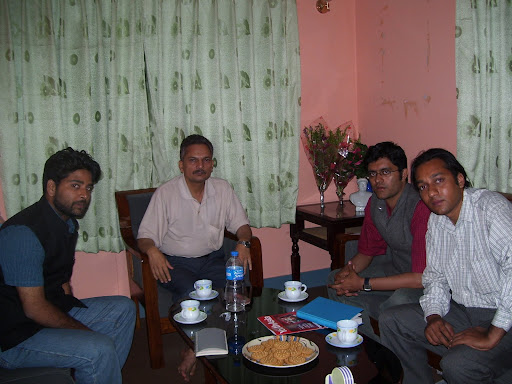 With Dr.Baburam Bhattarai at his residence
In the immediate, what kind of political and economic system did the Communist Party of Nepal (Maoist) [CPN(M)] have in mind for the republic of Nepal? A twohour conversation with Baburam Bhattarai, senior standing committee member of the politburo of the party helped clarify what the Maoists had in mind on the political and economic fronts.
We started our conversation with Bhattarai on the Maoist handling of the identity issue. Bhattarai felt that by taking up the cause of the janajatis and the dalits, the Maoists had won their staunch support, in the process empowering them in the course of the political struggle. On being asked as to why the Madhesi parties had halted the sweep of Maoist forces in many parts of the Terai, he mentioned that the people’s war was concentrated in the hills; it will take the Maoists some time to consolidate their presence in the Terai. The Maoists had articulated the issue of representation for the Madhesis along with radical social and agrarian reform and that was why the underprivileged such as the dalits and the landless had voted for them, even in the Terai. The Madhesi parties were particularly strong in one area of the Terai, Bhojpura, contiguous with the Bhojpuri-speaking parts of Bihar in India, but he was confident of “politically addressing the concerns of these people and winning them over”.
The conversation drifted towards larger questions: the “triangular ordering of the three contending class forces in Nepal, that of the monarchy representing feudalism and the comprador bourgeoisie, the parliamentary parties representing the small and weak (national) bourgeois class, and the revolutionary forces, the proletariat, the semi-proletariat and the poor peasantry, represented by the Maoists”. This “triangular class contention turned into a bipolar one after the initiation and development of the people’s war; the parasitic reactionary classes were polarised on one side, and on the other side were the progressive forces – the bourgeois class represented by the parliamentary parties and working people represented by the Maoists”. The Maoists had always emphasised a combination of mass and military approaches keeping in mind the “balance of (aforementioned) class forces”.
The phase of the people’s war, which entailed sacrifice and led to the loss of many lives, was in hindsight justified as it had achieved the abolition of the monarchy and the breaking of the back of feudalism, Bhattarai asserted. It is but obvious that over time the contradictions between the bourgeois forces and the Maoists are bound to lead to open con- flict; the Maoists were however con fident of handling this through the “continued support of the masses”. As for the masses themselves, their “expectations were huge”. This was one of the “two main challenges” of the present, the other being the “reactionary forces ganging up against Maoist rule” or sabotage of the current peace process, something that was already underway, he cautioned. “Crucial” to the writing of a progressive constitution was the “unity of the left forces” in Nepal, he emphasised.
On the question of development, he said that the primary focus in policymaking would remain “industrial capitalism – development of industrial capitalism – oriented towards socialism”. A pro-people and pro-poor government was necessary to transform underdeveloped Nepal and the Maoists were “studying the experiences of left-led governments in India”, Bhattarai said. Dependence on foreign aid routed through non-governmental organisations was a problem as these bodies were not accountable to the people. The Maoists would regulate the inflow of such aid and carefully route it to relevant areas, he said.
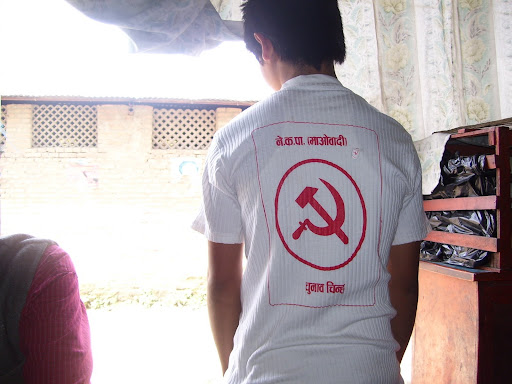
Bhattarai dismissed the demands to disband the Young Communist League (YCL) and expressed surprise that even a left party like the Communist Party of Nepal (Unified Marxist-Leninist) [CPN(UML)] had made such a demand. He said that the Maoists were willing to work for a radical constitution through the application of consensus, but at the same time, “would not give up basic issues such as land reform, particularly in the Terai”. He expected that the “coalition of reactionary forces allied with imperialism could hinder the process of writing the new constitution”.
Left Unity: Need of the Hour
Our next meeting was with Shyam Shrestha, former chief editor of Mulyankan, a left monthly magazine with a circulation of around 30,000 copies, and an active proponent of broad left unity. “Civil society” had an important role to play in the anti-monarchy protests and the eventual mass opposition to the emergency (the jan andolan II of April 2006), said Shyam Shrestha, when we met him at his home in Kirtipur, a picturesque suburb in the Kathmandu valley. “Kirtipur was the hub of the pro-democracy protests of 1989 and it was no different in 2006”, Shrestha emphatically mentioned. Along with other civil society activists, Shrestha had helped orchestrate the mass protests against the emergency and worked towards getting the mainstream parties, the Nepali Congress (NC) and the CPN(UML) together with the Maoists in a united struggle against the monarchy. He gave us an overview of the days leading to the lifting of the emergency and the spontaneous protests and blockades conducted by the people in and around Kathmandu, particularly along the Ring Road and in the blue-collar areas, such as Gongabu.
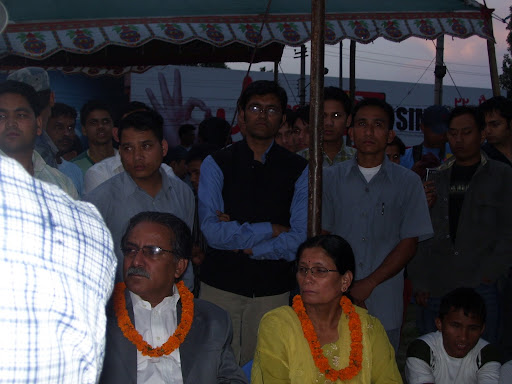 With Prachanda, the CPN(M) General Secretary
A prominent left intellectual, Shrestha was wary about the Maoists’ intention to foster industrial capitalism with foreign investment, worried that they would eventually follow essentially the same economic policies as the other mainstream political parties. On the criticism that the YCL was using strong-arm tactics, he suggested that this only happened in places where the local Maoist leadership was not “mature”. Above all, Shrestha felt that a broad left unity was the need of the hour in Nepal so that a “radical constitution” can be drafted by the constituent assembly.
Left Unity: Not for Now
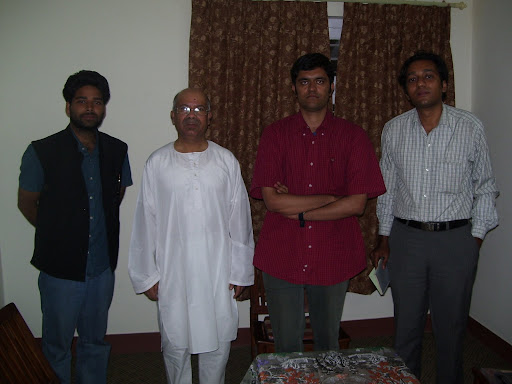 With Madhav Kumar Nepal of the CPN(UML)
But even as Shyam Shrestha strikes a chord for left unity, for a leading light of the CPN(UML), former general secretary, Madhav Kumar Nepal, this seems out of the question. Madhav Nepal is among the senior most communist leaders in the country and had a long tenure as general secretary of the party. In the course of the interview he gave us, he presented an elaborate overview of the left movement in Nepal. The CPN(UML)’s contribution to “people’s multiparty democracy” and their coming to power through the ballot were the party’s major accomplishments, he said. The party’s short-lived government in 1996 had undertaken a series of relief and development measures, enjoying the confidence of the people. However, an unfortunate split in the party had paved the way for the NC to entrench itself in power again; by the time the party reunited, it was too late to capture a majority, he pointed out.
As regards relations with the Maoists, he was committed to left unity in the country, but expressed deep anguish and anger against the activities of the YCL. He emphasised that despite the Maoist leadership’s repeated assurance to control their young cadre, the “cult of violence” unleashed against his party could not be tolerated any more. Support for coordinated action in drafting a new constitution was contingent upon the Maoist leadership containing its YCL cadre and this was the major sticking point in fraternal relations with the CPN(M), he argued. There were differences on the issue of federalism too; the carving of the country into federated regions based on ethnicity alone will not serve any purpose. Socio-political considerations and economic viability should govern any federal restructuring, apart from ethnicity, he said.
As we interacted with the people in the streets, taxi drivers, shopkeepers and others, we found that many who were formerly staunch supporters of the CPN(UML) had gravitated towards the Maoists. Despite positive memories of the short-lived CPN(UML) government in 1996, in the popular imagination, the party seemed to have lost its distinctiveness after having taken a series of vacillating and conciliatory political stands during the course of the people’s war.
Nepali Congress: Next Generation
We also met the spokesperson of the NC, Minendra Rijal. Interestingly, Rijal was critical of the Koirala leadership’s intention to continue in government. Rijal expressed his fears of a communist-led Nepal under the leadership of the Maoists. “We have no intention of letting Nepal become a communist state”, he said. The NC was also opposed to the integration of the People’s Liberation Army with the Nepal army. Rijal’s statements clearly established that sections of the NC, given their inherent antagonism towards the Maoists, were bent on destabilising the consensual peace process.
It was heartening to know that the younger generation of the NC, those who came into prominence during the jan andolan II of April 2006, were staunch republicans. One youth leader of the NC who had helped organise multiple rallies during the April movement and has been a popular campaigner since then was Gagan Thapa. We met him at a restaurant at Darbar Marg. Thapa had been active in student politics before his rise in prominence. He had actively campaigned during the CA elections, but was not given a ticket in the first past the post polls, only to be nominated to the assembly through the proportional representation route.
 Gagan Thapa of the Nepali Congress
Thapa analysed the Maoist victory, saying how the areas which were under effective Maoist control during the “people’s war” phase were literally out of bounds for the NC and how the elected representatives from this region had virtually neglected any mass contact with the people. It was no wonder that the Maoists had won over large sections of people who had hitherto voted for the mainstream parties. He was critical of the NC’s senior leaders who vacillated on the demand for a republic by playing “old style conservative politics”. Only a resolution supported by party members who had participated in the 2005 movement could force the leadership to accept the demand for the declaration of a republic as one of the NC’s slogans.
There was a debate within the party whether or not to join the new government. He was frank enough to suggest that many of the old guard in the party were afraid of coming out of government as they were apprehensive that the Maoists would replace them in dispensing “patronage” once they took over the reins of power. The Maoist leadership had the strategic acumen as well as the organisational strength to remain in power for a long time by addressing the precarious living conditions of the people, he felt. He expected the NC to eventually occupy the liberal democratic space in Nepali politics. Gagan Thapa also gave us an insight into the hold of US and Indian diplomats over Nepali polity. He was concerned about international meddling in Nepali affairs during the constitutionmaking phase and asserted that the younger republican members of the NC would strive for a change in leadership and policies in the party. The Nepali Bourgeoisie During our stay, many of the main headlines and first page news in the major national dailies were about meetings between the Maoists and the representatives of commerce and industry. The main refrain was the assurances given by the Maoists about supporting national capital and forging public- private partnerships.
We met Shekhar Golchha, executive director with Golchha organisation, a big private manufacturing and trading company, the largest private employer in Nepal. We asked him about his concerns regarding the coming of a Maoist-led government to power. Golchha said that the end of the people’s war and the return to peace were positive steps. The recent verdict was for peace and he hoped that the Maoists would be able to ensure peace and stability which were necessary for business prosperity. He was under the impression, after talking to a section of the Maoist leadership, that labour-capital relations will be cordial once the Maoists came to power.
He was welcoming of the fact that the focus of the Maoists was to protect “national capital”; he wanted some amount of protection vis-a-vis foreign competition, but was also hoping for foreign investment in select areas, such as power infrastructure. He was also hopeful of expansion of the basket of goods from Nepal enjoying zero customs/import duty status in India. He was not quite appreciative of proposals for free trade and a common market as he was apprehensive of a flooding of the Nepali market with Indian goods, as companies in India had “greater economies of scale”. He also wanted foreign direct investment to be regulated and a preference for joint ventures with the participation of local firms.
Our next meeting was with Sujiv Shakya, a management consultant and president of Tara Management, a managing company handling several diversified businesses in Nepal, including the hydro power sector. Shakya was sceptical of the political processes in place under the leader ship of the Maoists. He was against any form of patronage that was inevitably a feature of Nepali polity. He did not want any form of political interference in any industrial activity and quoted the Indian experience of the last few years (laissez faire economic reforms) to buttress his argument. He particularly wanted labour reforms. The problem of implementation of big industrial projects was precisely due to the fact that it was difficult to underwrite such projects in times of political crisis. When we asked him about his opinion regarding the Maoists’ statements about the “development of industrial capitalism oriented towards socialism”, Shakya was dismissive and said that these moves were only going to encourage “crony capitalism”. We could thus get two views from the “representatives” of capital.
Towards a Vibrant Democracy
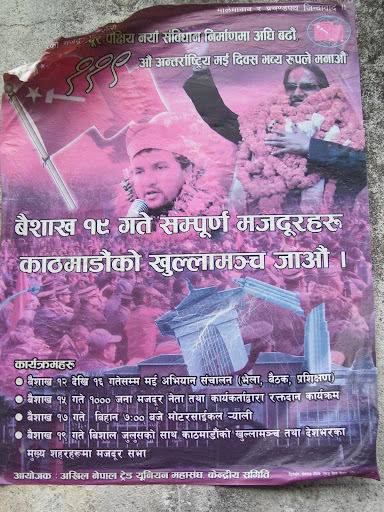 A victory poster of the CPN(Maoist)
We now needed to take some time off and so we headed to the landmark places, particularly the Narayanhiti palace occupied by the king and the new venue for the constituent assembly in New Baneswor. We were particularly struck by the proximity of the Narayanhiti palace to the huge compound housing the United States embassy. Every political leader we talked to, every journalist who had inside information about the happenings in diplomatic circles expressed concern about interference by the Americans or the Indians as had happened in the past.
 Narayanhiti Palace
We were keen on travelling to the eastern parts too, but due to lack of time as well as a travel blockade in those areas, we had to cut short our visit and return to India. We took an unconventional route to Hethouda on the east-west highway and crossed the border through Birgunj into Bihar.
 Red signal to the monarchy
In our 15-day sojourn which ended on May 13, we were witness to history in the making in Nepal. Our meetings with farmers, labourers, guerrillas, industrialists, journalists, politicians, and representatives of the civil society were richly rewarding. Nepal’s transformation into a republic had been facilitated by the coming together of progressives, democrats and communists and because of the peoples’ overwhelming support for such a culmination. It was the collective effort of the long suppressed citizenry that brought the monarchy down.
The talk of diplomatic intrigue and international interference worried us the most. The possibility of sabotage of the process of building a radically new Nepal should not be underestimated as the country is seen by imperialists as a launching pad of destabilisation strategies against its neighbours, even as the latter see Nepal through the lens of competitive geopolitics. There is also the presence of threats from obscurantist forces within Nepal and in India. The historic endeavour of writing a constitution for the federal democratic republic of Nepal and building a self-reliant industrial economy rests on the ability of the polity to maintain the bonhomie and consensus generated in the peace process. The long march to a vibrant democracy in Nepal has just begun.
(End)
Series of articles published in Economic and Political Weekly

The three team members in front of Darbar Square in the night
As we entered the Kathmandu valley and made our way into the three adjoining cities of Kathmandu, Bhaktapur and Patan, it was abundantly evident that we had reached the political and cultural centre of Nepal. We parked ourselves at a hotel near the historic Darbar Square, close to the tourist district of Thamel, as Prashant Jha, consulting editor of Himal, helped fix our political itinerary of meetings with leading lights of the major political parties, public intellectuals and the representatives of commerce and industry.
Madhesi Concerns
The first of our series of meetings was with Upendra Yadav, chairman of the Mad
 hesi Janadhikar Forum (MJF). He gave us an overview of the “discrimination” faced by the Madhesis owing to “Pahadi racism”, as he put it. Reeling off statistics about Madhesi under-representation in Nepal’s politico-economic-administrative structure, he made a case for a single autonomous state to be carved out of the Terai region and “self rule” that would help address the concerns of the Madhesis. When reminded that the Tharus and other sections of the inner and outer Terai had reservations about a single Madhes state, Yadav was dismissive; according to him, this was part of a “conspiracy to divide Madhes”. It “was in the Tharus’ interest to have a separate Madhes and they were misled by the Maoists during the elections”, he argued.
On the caste question and the question of radical land reform Yadav was evasive, saying that social and economic transformation was secondary to the ushering in of a truly federal structure. Indeed, he did not believe that the Maoist model of economic redistribution was necessary in the Terai; all that was required was the infusion of investment and scientific inputs in agriculture. Yadav scoffed at the allegation that India had a role to play in stoking the Madhesi identity issue, saying that India had always sided with the Nepali ruling classes of pahadi origins.
Regarding the Terai Madhesi Loktantrik Party (TMLP), the other Madhesi outfit that had done quite well in the constituent assembly elections, we were told that the TMLP was dominated by an upper caste leadership in contrast to the backward caste dominated MJF. But clearly, the strong performance of the Madhesi parties had ensured that the issue of identity and representation was going to be high on the agenda of the deliberations in the constituent assembly. The Maoists in particular had a federal model of autonomy that addressed headlong the questions of ethnicity and representation as well as redistribution.
Leading Figure of the CPN(M)
 With Dr.Baburam Bhattarai at his residence
In the immediate, what kind of political and economic system did the Communist Party of Nepal (Maoist) [CPN(M)] have in mind for the republic of Nepal? A twohour conversation with Baburam Bhattarai, senior standing committee member of the politburo of the party helped clarify what the Maoists had in mind on the political and economic fronts.
We started our conversation with Bhattarai on the Maoist handling of the identity issue. Bhattarai felt that by taking up the cause of the janajatis and the dalits, the Maoists had won their staunch support, in the process empowering them in the course of the political struggle. On being asked as to why the Madhesi parties had halted the sweep of Maoist forces in many parts of the Terai, he mentioned that the people’s war was concentrated in the hills; it will take the Maoists some time to consolidate their presence in the Terai. The Maoists had articulated the issue of representation for the Madhesis along with radical social and agrarian reform and that was why the underprivileged such as the dalits and the landless had voted for them, even in the Terai. The Madhesi parties were particularly strong in one area of the Terai, Bhojpura, contiguous with the Bhojpuri-speaking parts of Bihar in India, but he was confident of “politically addressing the concerns of these people and winning them over”.
The conversation drifted towards larger questions: the “triangular ordering of the three contending class forces in Nepal, that of the monarchy representing feudalism and the comprador bourgeoisie, the parliamentary parties representing the small and weak (national) bourgeois class, and the revolutionary forces, the proletariat, the semi-proletariat and the poor peasantry, represented by the Maoists”. This “triangular class contention turned into a bipolar one after the initiation and development of the people’s war; the parasitic reactionary classes were polarised on one side, and on the other side were the progressive forces – the bourgeois class represented by the parliamentary parties and working people represented by the Maoists”. The Maoists had always emphasised a combination of mass and military approaches keeping in mind the “balance of (aforementioned) class forces”.
The phase of the people’s war, which entailed sacrifice and led to the loss of many lives, was in hindsight justified as it had achieved the abolition of the monarchy and the breaking of the back of feudalism, Bhattarai asserted. It is but obvious that over time the contradictions between the bourgeois forces and the Maoists are bound to lead to open con- flict; the Maoists were however con fident of handling this through the “continued support of the masses”. As for the masses themselves, their “expectations were huge”. This was one of the “two main challenges” of the present, the other being the “reactionary forces ganging up against Maoist rule” or sabotage of the current peace process, something that was already underway, he cautioned. “Crucial” to the writing of a progressive constitution was the “unity of the left forces” in Nepal, he emphasised.
On the question of development, he said that the primary focus in policymaking would remain “industrial capitalism – development of industrial capitalism – oriented towards socialism”. A pro-people and pro-poor government was necessary to transform underdeveloped Nepal and the Maoists were “studying the experiences of left-led governments in India”, Bhattarai said. Dependence on foreign aid routed through non-governmental organisations was a problem as these bodies were not accountable to the people. The Maoists would regulate the inflow of such aid and carefully route it to relevant areas, he said.
Bhattarai dismissed the demands to disband the Young Communist League (YCL) and expressed surprise that even a left party like the Communist Party of Nepal (Unified Marxist-Leninist) [CPN(UML)] had made such a demand. He said that the Maoists were willing to work for a radical constitution through the application of consensus, but at the same time, “would not give up basic issues such as land reform, particularly in the Terai”. He expected that the “coalition of reactionary forces allied with imperialism could hinder the process of writing the new constitution”.
Left Unity: Need of the Hour
Our next meeting was with Shyam Shrestha, former chief editor of Mulyankan, a left monthly magazine with a circulation of around 30,000 copies, and an active proponent of broad left unity. “Civil society” had an important role to play in the anti-monarchy protests and the eventual mass opposition to the emergency (the jan andolan II of April 2006), said Shyam Shrestha, when we met him at his home in Kirtipur, a picturesque suburb in the Kathmandu valley. “Kirtipur was the hub of the pro-democracy protests of 1989 and it was no different in 2006”, Shrestha emphatically mentioned. Along with other civil society activists, Shrestha had helped orchestrate the mass protests against the emergency and worked towards getting the mainstream parties, the Nepali Congress (NC) and the CPN(UML) together with the Maoists in a united struggle against the monarchy. He gave us an overview of the days leading to the lifting of the emergency and the spontaneous protests and blockades conducted by the people in and around Kathmandu, particularly along the Ring Road and in the blue-collar areas, such as Gongabu.
 With Prachanda, the CPN(M) General Secretary
A prominent left intellectual, Shrestha was wary about the Maoists’ intention to foster industrial capitalism with foreign investment, worried that they would eventually follow essentially the same economic policies as the other mainstream political parties. On the criticism that the YCL was using strong-arm tactics, he suggested that this only happened in places where the local Maoist leadership was not “mature”. Above all, Shrestha felt that a broad left unity was the need of the hour in Nepal so that a “radical constitution” can be drafted by the constituent assembly.
Left Unity: Not for Now
 With Madhav Kumar Nepal of the CPN(UML)
But even as Shyam Shrestha strikes a chord for left unity, for a leading light of the CPN(UML), former general secretary, Madhav Kumar Nepal, this seems out of the question. Madhav Nepal is among the senior most communist leaders in the country and had a long tenure as general secretary of the party. In the course of the interview he gave us, he presented an elaborate overview of the left movement in Nepal. The CPN(UML)’s contribution to “people’s multiparty democracy” and their coming to power through the ballot were the party’s major accomplishments, he said. The party’s short-lived government in 1996 had undertaken a series of relief and development measures, enjoying the confidence of the people. However, an unfortunate split in the party had paved the way for the NC to entrench itself in power again; by the time the party reunited, it was too late to capture a majority, he pointed out.
As regards relations with the Maoists, he was committed to left unity in the country, but expressed deep anguish and anger against the activities of the YCL. He emphasised that despite the Maoist leadership’s repeated assurance to control their young cadre, the “cult of violence” unleashed against his party could not be tolerated any more. Support for coordinated action in drafting a new constitution was contingent upon the Maoist leadership containing its YCL cadre and this was the major sticking point in fraternal relations with the CPN(M), he argued. There were differences on the issue of federalism too; the carving of the country into federated regions based on ethnicity alone will not serve any purpose. Socio-political considerations and economic viability should govern any federal restructuring, apart from ethnicity, he said.
As we interacted with the people in the streets, taxi drivers, shopkeepers and others, we found that many who were formerly staunch supporters of the CPN(UML) had gravitated towards the Maoists. Despite positive memories of the short-lived CPN(UML) government in 1996, in the popular imagination, the party seemed to have lost its distinctiveness after having taken a series of vacillating and conciliatory political stands during the course of the people’s war.
Nepali Congress: Next Generation
We also met the spokesperson of the NC, Minendra Rijal. Interestingly, Rijal was critical of the Koirala leadership’s intention to continue in government. Rijal expressed his fears of a communist-led Nepal under the leadership of the Maoists. “We have no intention of letting Nepal become a communist state”, he said. The NC was also opposed to the integration of the People’s Liberation Army with the Nepal army. Rijal’s statements clearly established that sections of the NC, given their inherent antagonism towards the Maoists, were bent on destabilising the consensual peace process.
It was heartening to know that the younger generation of the NC, those who came into prominence during the jan andolan II of April 2006, were staunch republicans. One youth leader of the NC who had helped organise multiple rallies during the April movement and has been a popular campaigner since then was Gagan Thapa. We met him at a restaurant at Darbar Marg. Thapa had been active in student politics before his rise in prominence. He had actively campaigned during the CA elections, but was not given a ticket in the first past the post polls, only to be nominated to the assembly through the proportional representation route.
 Gagan Thapa of the Nepali Congress
Thapa analysed the Maoist victory, saying how the areas which were under effective Maoist control during the “people’s war” phase were literally out of bounds for the NC and how the elected representatives from this region had virtually neglected any mass contact with the people. It was no wonder that the Maoists had won over large sections of people who had hitherto voted for the mainstream parties. He was critical of the NC’s senior leaders who vacillated on the demand for a republic by playing “old style conservative politics”. Only a resolution supported by party members who had participated in the 2005 movement could force the leadership to accept the demand for the declaration of a republic as one of the NC’s slogans.
There was a debate within the party whether or not to join the new government. He was frank enough to suggest that many of the old guard in the party were afraid of coming out of government as they were apprehensive that the Maoists would replace them in dispensing “patronage” once they took over the reins of power. The Maoist leadership had the strategic acumen as well as the organisational strength to remain in power for a long time by addressing the precarious living conditions of the people, he felt. He expected the NC to eventually occupy the liberal democratic space in Nepali politics. Gagan Thapa also gave us an insight into the hold of US and Indian diplomats over Nepali polity. He was concerned about international meddling in Nepali affairs during the constitutionmaking phase and asserted that the younger republican members of the NC would strive for a change in leadership and policies in the party. The Nepali Bourgeoisie During our stay, many of the main headlines and first page news in the major national dailies were about meetings between the Maoists and the representatives of commerce and industry. The main refrain was the assurances given by the Maoists about supporting national capital and forging public- private partnerships.
We met Shekhar Golchha, executive director with Golchha organisation, a big private manufacturing and trading company, the largest private employer in Nepal. We asked him about his concerns regarding the coming of a Maoist-led government to power. Golchha said that the end of the people’s war and the return to peace were positive steps. The recent verdict was for peace and he hoped that the Maoists would be able to ensure peace and stability which were necessary for business prosperity. He was under the impression, after talking to a section of the Maoist leadership, that labour-capital relations will be cordial once the Maoists came to power.
He was welcoming of the fact that the focus of the Maoists was to protect “national capital”; he wanted some amount of protection vis-a-vis foreign competition, but was also hoping for foreign investment in select areas, such as power infrastructure. He was also hopeful of expansion of the basket of goods from Nepal enjoying zero customs/import duty status in India. He was not quite appreciative of proposals for free trade and a common market as he was apprehensive of a flooding of the Nepali market with Indian goods, as companies in India had “greater economies of scale”. He also wanted foreign direct investment to be regulated and a preference for joint ventures with the participation of local firms.
Our next meeting was with Sujiv Shakya, a management consultant and president of Tara Management, a managing company handling several diversified businesses in Nepal, including the hydro power sector. Shakya was sceptical of the political processes in place under the leader ship of the Maoists. He was against any form of patronage that was inevitably a feature of Nepali polity. He did not want any form of political interference in any industrial activity and quoted the Indian experience of the last few years (laissez faire economic reforms) to buttress his argument. He particularly wanted labour reforms. The problem of implementation of big industrial projects was precisely due to the fact that it was difficult to underwrite such projects in times of political crisis. When we asked him about his opinion regarding the Maoists’ statements about the “development of industrial capitalism oriented towards socialism”, Shakya was dismissive and said that these moves were only going to encourage “crony capitalism”. We could thus get two views from the “representatives” of capital.
Towards a Vibrant Democracy
 A victory poster of the CPN(Maoist)
We now needed to take some time off and so we headed to the landmark places, particularly the Narayanhiti palace occupied by the king and the new venue for the constituent assembly in New Baneswor. We were particularly struck by the proximity of the Narayanhiti palace to the huge compound housing the United States embassy. Every political leader we talked to, every journalist who had inside information about the happenings in diplomatic circles expressed concern about interference by the Americans or the Indians as had happened in the past.
 Narayanhiti Palace
We were keen on travelling to the eastern parts too, but due to lack of time as well as a travel blockade in those areas, we had to cut short our visit and return to India. We took an unconventional route to Hethouda on the east-west highway and crossed the border through Birgunj into Bihar.
 Red signal to the monarchy
In our 15-day sojourn which ended on May 13, we were witness to history in the making in Nepal. Our meetings with farmers, labourers, guerrillas, industrialists, journalists, politicians, and representatives of the civil society were richly rewarding. Nepal’s transformation into a republic had been facilitated by the coming together of progressives, democrats and communists and because of the peoples’ overwhelming support for such a culmination. It was the collective effort of the long suppressed citizenry that brought the monarchy down.
The talk of diplomatic intrigue and international interference worried us the most. The possibility of sabotage of the process of building a radically new Nepal should not be underestimated as the country is seen by imperialists as a launching pad of destabilisation strategies against its neighbours, even as the latter see Nepal through the lens of competitive geopolitics. There is also the presence of threats from obscurantist forces within Nepal and in India. The historic endeavour of writing a constitution for the federal democratic republic of Nepal and building a self-reliant industrial economy rests on the ability of the polity to maintain the bonhomie and consensus generated in the peace process. The long march to a vibrant democracy in Nepal has just begun.
(End)
Series of articles published in Economic and Political Weekly
Subscribe to:
Posts (Atom)