Showing posts with label Andhra Pradesh. Show all posts

Monday, February 16, 2009

Grand Alliance takes root

Competitive populism dominates the agenda for all political formations in upcoming elections in Andhra Pradesh.

The opposition parties, including the Telugu Desam party (TDP), the left parties and the Telengana Rashtra Samiti (TRS), in the state have formalised a grand alliance against the Congress party. This is a similar coming together of the opposition parties against the ruling incumbent, as had happened five years ago against the then ruling TDP.

In the 2004 assembly and Lok Sabha elections, the TDP had an alliance with the Bharatiya Janata Party (BJP), the main constituent of the National Democratic Alliance (NDA). And the seat sharing between the Congress and the TRS as well as between the left parties and the Congress helped these parties to collectively overcome the TDP, which received a trouncing, retaining merely 47 assembly seats and winning only five parliamentary seats. The broad alliance of the opposition was able to capitalise on the widespread resentment with the economic reforms followed by the TDP and also managed to win the support of large sections of the populace, particularly from rural areas with populist promises such as free electricity for farmers.

During the tenure of the Congress government however, a gradual withering away of the alliance took place with the TRS coming off it owing to the non-realisation of its goal of a separate Telangana state and with the left parties adopting confrontationist positions, particularly in the course of a land struggle. Within a few years into the tenure, the TDP disavowed any relations that it still had with the BJP, changed tack from its “reformist” past and adopted populist slogans, and soon enough found itself in alliance with the left parties. The TDP also managed a volte-face on the Telangana issue, endearing the TRS into the grand alliance as it stands today.

The Congress government led by Chief Minister Rajasekara Reddy has been successful in projecting a populist image of itself during its tenure. Owing to measures such as the free provision of electricity for agriculture, steps taken in building irrigation capabilities across Andhra Pradesh, or the Indiramma housing schemes for the homeless, the Arogyashree health scheme, the government has achieved a semblance of popularity and retaining of support base across the state. The opposition has duly adopted a strategy of scrutinising these schemes and protesting the deficiencies in them. And despite the opposition's legitimate criticisms of malfeasance by the government, the incumbent's success in delivering a populist message in comparison to the “reformist” predecessor has been there for all to see. And in that sense, there has been an instrumental reason for the coming together of disparate and erstwhile rival political parties such as the Left, the TDP and the TRS in coalition against the Congress.

The left parties reason out their political stance in the state as flowing from their national goal of preventing the Congress and the BJP from coming to power. Locally, they affirm that their electoral strategies would not affect their political campaigns and socio-economic struggles, which has seen an increase in support for them. Whether that is indeed the case is questionable as disparate alliances determined by electoral criteria have not helped the Left in retaining their ideological influence on governments formed after elections. Even if the success of the coalition is assumed, it is indeterminate if the TDP (as the largest party in the bloc) would be any different in its stances on socio-economic matters and development trajectories from the others in the ruling class segments.

What prevents the elections from becoming a two-horse race – the Congress versus the grand opposition (the BJP has been relegated to a minor presence in the state) is the dark horse presence of the newly formed political outfit, the Praja Rajyam Party (PRP) anchored by the popular film actor Chiranjeevi. Despite overtures and discussions between the PRP and the Left, the latter decided to throw in their lot with the TDP as the PRP refused to join the grand coalition. With a purported support base of youth, and other marginalised sections of the populace, the PRP hopes to make a significant dent in its first attempt in electoral politics. Unsurprisingly the political language of this party also draws from populism and concern for the poor.

Electorally however, considerations such as identity, as in particular caste combinations still play an important role in determining the success or not of such coalitions. The PRP is expected to draw a good chunk of votes from the Kapu community, assumed to favour the Congress party traditionally. And in that regard, the relatively popular Congress party faces a formidable challenge posed by the grand alliance and the PRP.

The biggest loser even before the elections, seems to be the BJP. The party has been able to neither carve a presence nor befriend a regional ally in the state – a trend that resembles the situation in other southern states excepting Karnataka, surely affecting the overall prospects of the NDA in the parliamentary elections.

Editorial written for the Economic and Political Weekly

Monday, November 17, 2008

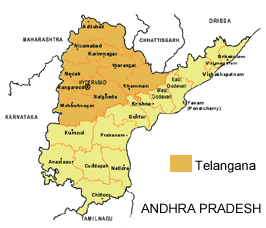
Telangana Demand

The demand for Telangana state has new takers as the Telugu Desam Party changes tack on the issue.

The decision of the Telugu Desam Party (TDP) to support the creation of a separate Telangana state is a volte face. The decision is also significant because the TDP is the principal opposition party in the state and has hithero vociferously opposed such a move. It is clear that the TDP’s moves are aimed at attracting support in the Telangana region. The TDP had always positioned itself as a party with a base in all the Telugu-speaking regions of Andhra Pradesh.

The TDP split in 2001 leading to the formation of the Telangana Rashtra Samiti (TRS), which renewed the agitation for a separate state but with no returns so far. The TRS alliance with the Congress in the last assembly elections in 2004 had hurt the TDP and the latter’s recent change in position has brought it closer to the Telangana party, thereby creating the possibility of an alliance against the ruling Congress Party in the assembly elections in 2009.

Political calculations apart, the TDP’s about-turn means that the idea of a separate Telangana state now enjoys currency among almost all of the major political parties in the state except for the non-committal Congress, and the Communist Party of India (Marxist) – CPI(M). Even the newly formed Praja Rajyam of the actor Chiranjeevi has recently suggested that it is open to the idea of a separate Telangana.

More than five decades after the state of Andhra Pradesh was constituted by merging the Telugu-speaking areas that were part of the Nizam of Hyderabad’s dominions with the linguistic coterminous areas of Madras Presidency, grievances over lopsided development remain. The Telangana region suffers from inadequate irrigation, higher rates of poverty, poorer health facilities and higher unemployment in comparison to other regions in the state. One of the reasons for underdevelopment is the fact that Telangana inherited a feudal political and economic structure from the days of the Nizam, other reasons relate to the failure by successive governments to implement promised measures in the state.

The persistence of these grievances among the populace of the region has resulted in many a political party eventually coming to support the demand for a separate state. Even the Congress Party, following a Congress Working Committee resolution that was adopted before the 2004 assembly elections, had promised to take up the issue, through the aegis of a second state reorganisation commission to look into the formation of new states. Inaction and indifference by the Congress forced the TRS to break its alliance with the party and withdraw from the United Progressive Alliance. The CPI(M), on the other hand, has consistently rejected the formation of a new state, arguing that the neglect of the region can be rectified by focusing on prioritised development of the backward areas in Andhra Pradesh.

The formation of Andhra Pradesh after a concerted movement marked the beginning of the linguistically determined federal reorganisation process. The coherent division on a linguistic basis has, contrary to the fears expressed in the mid-1950s, helped strengthen the democratic federal framework. Yet, the political institutional set-up and the mode of development (primarily capitalist) within several states have created intra-state disparities. The opposition to the demand for a Telangana state is posited on the logic that the creation of such a state would open a Pandora’s box for other intrastate regional areas to stake their claims for separate states as well. This argument underestimates the alienation of backward regions.

Many grievances gather emotive steam through appeals to cultural differences. That is when the logic of “linguistic coherence” inevitably loses appeal. It is obvious that only a focus on removing disparities can prevent such situations, but it requires political will to address structural inequalities. In the case of Telangana, for example, land reforms and other socio-economic measures to address poverty and semi-feudalism should be the immediate remedy. But with the political leadership more interested in a model of development that is decidedly urban-centric, private investment-driven and engaged only in token welfarism, is it possible to prevent the demand for a new state?

Editorial written for the Economic and Political Weekly

Saturday, August 11, 2007

Betrayal of a Mandate

To use violence against people demanding government action on social and economic issues is second nature for a state that deals with such situations as they were only a question of maintaining “law and order”. The gunning down of six left activists in Mudigonda of Khammam district of Andhra Pradesh on July 28 during a bandh called by the CPI(M) and CPI to protest the failure of the government to redistribute land is only the most recent example of the state showing its brutal face when confronted with genuine demands. This has been how governments at the centre and the states have, since the 1950s, responded to movements seeking redistribution of agricultural land.

It is also very common for political parties to promise land reform during their election campaigns, but to very quickly retract on these commitments. In Andhra Pradesh, the Telugu Desam Party (TDP), when it came to power for a second time in 1994 with a promise to implement welfare measures, took the path of neoliberalism under Chandrababu Naidu (after he was re-elected in 1999), only to be discredited in the eyes of the people and then drubbed at the polls in 2004. It was the backlash against the TDP’s regressive policies in the state that brought the Congress, led by Y S Rajasekhara Reddy, to power, but the present state government has not shown itself to be very different from its predecessor in the manner in which it has addressed the land issue. The inaction of the state government is a betrayal of the mandate of 2004, for redistribution of land was one of the important campaign promises of the Congress Party in the state assembly elections of that year.

The Andhra Pradesh Assignment Lands (Prohibition of Transfers) Act, 1977 was supposed to enable the state to distribute land to the poor. The Act had been passed to prohibit the sale or alienation of land assigned for distribution, to any third party. But the Congress government has amended the same Act to regularise unauthorised possession of assigned land. From private encroachment of the land meant for redistribution to illegal buying of such land from the poor in the name of “developing the land” and selling it for higher returns, the government has allegedly encouraged all kinds of malpractices. The government claims that it has distributed 4.37 lakh acres of land. However the CPI(M) and CPI allege that concrete steps have not been taken to implement the suggestions of the Koneru Ranga Rao Committee (set up by the Congress government in 2004) that came up with a list of measures to effect redistribution in accordance with already framed laws.

The left parties had demanded that the recommendations made in the Koneru Committee’s report be implemented and an independent authority be formed to monitor the implementation of the redistribution process as well as an ombudsman be appointed for the Indiramma housing project for the poor, which has seen a number of irregularities. The bandh call on July 28 was the culmination of the agitation, which had been going on for nearly three months.

The police were at their most brutal in Mudigonda. The use of AK-47s against unarmed protesters is reflective of what the state really thinks about people’s protests. That the use of firearms must be the last resort and only under extreme duress are rules that are too often disregarded by the police. In the present case, the firing upon the protestors was ordered even as they were being lathi charged. The measures taken by the chief minister after the incident to punish the personnel involved and to compensate the victims will not be enough to mollify the anger that has erupted against this regime.

The drubbing that Rajasekhara Reddy’s predecessor received at the polls should forewarn the Congress Party in Andhra Pradesh. The incumbent government has to demonstrate that it is serious about addressing the issue of land reform. Only that would be a fitting compensation to the activists who lost their lives in the police firing in Mudigonda on July 28. But is the Congress government in the state capable of such action?

Editorial written for the Economic and Political Weekly