It can be viewed here.
Friday, April 16, 2010
Interview with Sukumar Muralidharan on Iraq
Did an interview for Newsclick with Sukumar Muralidharan on Iraq post elections -


Tuesday, April 06, 2010
For the Elites
What kind of university system does the government propose by allowing foreign universities?
An EPW Editorial.
Divided after the Invasion
Elections have not closed the ethnic fault lines that have torn apart a post-invasion Iraq.
An EPW Editorial.
Monday, March 22, 2010
Flawed Civil Nuclear Liability Bill
All eyes are on how the government reworks the Civil Nuclear Liability Bill
An EPW Editorial
Wednesday, March 17, 2010
Tuesday, March 09, 2010
The Congress' pusillanimity and "real" interests
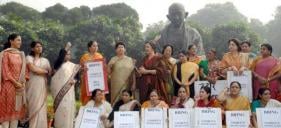
On the historic occasion of the 100th anniversary of "Women's Day", there were more than a few expectations. On the positive side, considering more than two thirds support for the "Women's Reservation Bill" -which envisages 33% reservation for women in parliamentary and legislative assembly constituencies in the country- the bill was supposed to be passed today with far more ease than envisaged in all these years of talking about the bill. It was expected that the overwhelming consensus on the issue would ensure that despite the vociferous but miniscule opposition, the bill would have been passed today on a momentous day. On the flip side, that "ruffian" members of parliament, belonging to the Rashtriya Janata Dal and the Samajwadi Party would take recourse to the crudest methods to prevent any discussion or passing of the Women's Reservation Bill in both the Houses was very much expected.
Yet, to the frustration and anger of many of us, only the negative expectation bore fruit. The "ruffian" members opposed to the bill behaved in a manner that was even worse than expected. Snatching papers from the Rajya Sabha chairperson and vice president Hamid Ansari was just a sampler of a bunch of crude acts from uncouth MPs wanting to disrupt the sureshot passage of the bill.
The Congress party, instead of seizing the initiative suddenly developed cold feet, lacking a strategy to tackle the lumpen but dedicated opposition from parties which were also giving outside support to the ruling coalition. The rationale provided was that, since action on the bill necessitated a Constitutional Amendment, precedence and Parliamentary culture demanded that the Bill be debated. And since the discussion was not possible in a situation of pandemonium as created by the aforementioned parties, the logical conclusion was to adjourn Parliament to the next day.
Such an argument seems very specious. As mentioned earlier, the expectations of disruption were always very high. It would easily been possible to evict the lumpen MPs who were already taking Parliamentary behaviour to depths scratching the nadir of indecorum. Rules of house behaviour clearly dictate that in certain irretrievable circumstances, MPs can indeed be evicted by House marshalls and who could enter the House in case of a vote. But the pusillanimous Congress only wanted to play "safe", and the real reason is apparent.
The threat of withdrawal of support from the RJD and the SP meant that the buffer of MPs beyond the 272 magic figure (of majority) had suddenly dried up for the ruling coalition. If numbers stood as they were now, the Congress led UPA would have only 275 MPs in support of the ruling coalition. Considering that the Finance Bill was due to be debated and voted on, not very long later, the Congress surely got jittery looking at the insecurity of the numbers. The BJP and the left parties, who otherwise support the Women's Reservations Bill have expressed opposition to various features of the Union Budget and are expected to vote against the government. In its anxiety to prevent a loss in support over the Finance Bill, the government thought it safe to prolong the hiatus vis-a-vis the long pending Women's Reservation Bill either by atleast trying to buy time and winning over the recalcitrant outfits by tomorrow or by simply bringing the Bill to cold storage.
Either ways, if the Congress does not show the enthusiasm to pass the bill, it will betray a strong anti-people angle to its functioning that has been starkly evident ever since its re-election to power in 2009. Be it over the callous provisions of the Nuclear Liability Bill in order to satisfy American nuclear business suppliers at the cost of potential hazard victims in India or in the manner a pro-corporate and inflationary budget was passed at a time when food prices had affected most sections of the Indian population, the starkly sectional character of UPA-II, favouring the rich and well off over everyone else is evident.
This writer would love to be proved wrong on March the 9th by the ruling coalition and if it shows the gumption to take on the minority few rabble rousers who are opposed to the Women's Reservation Bill and get it passed - a long overdue step in Parliamentary action that has wide public and legislative approval.
Tuesday, March 02, 2010
Talking and its merits
The governments of India and Pakistan owe it to their citizens to engage in talks and to act substantively.
An EPW Editorial
An EPW Editorial
Monday, March 01, 2010
Friday, February 26, 2010
The Moratorium Announcement on Bt Brinjal
www.Newsclick.in presentation on the Bt Brinjal moratorium announcement
Monday, February 22, 2010
Development and Displacement: Resentment in the Kutch

A visit to the coastal areas adjoining the Mundra port in the Kutch reveals discontent among fisherfolk, traders and pastoralists over the creation of a special economic zone in the area. Apart from environmental concerns, the traditional livelihoods of residents in the area have also been affected by the new industrial projects, leading to organised protests, as witnessed in Bhadreswar village a few months ago.
The Full article (pdf format) can be read here in the Economic and Political Weekly
The Full article (pdf format) can be read here in the Economic and Political Weekly
Tuesday, February 16, 2010
Competitive 'Exclusionism'
The state has to assert itself to defeat the politics of exclusion of the two Senas in Maharashtra.
An EPW Editorial on the events in Maharashtra related to the activities of the two nativist (and fascist) Senas.
Sunday, February 14, 2010
Back to Constitution Writing
The Nepali Maoists' reiteration to focus on Constitution writing is a significant boost to the process.
Saturday, February 13, 2010
Tuesday, February 09, 2010
Rajapaksa’s Triumph
A united but disparate opposition in Sri Lanka is unable to scuttle Mahinda Rajapaksa’s bid for a second term.
An EPW Editorial.
Monday, January 25, 2010
The Right to Vote
Indian citizens everywhere should have the right to vote, but the principle of local representation cannot be violated.
EPW Editorial on NRI voting.
Sunday, January 24, 2010
An unfortunate exclusion
Pakistan’s interior minister made a statement that “India was not serious about the peace process” by the manner in which the cricketers were excluded. Such a conclusion is unwarranted as it does not understand the way the league functions
The decision by franchise owning businessmen to not to pick any of the Pakistani players available in the Indian Premier League (IPL) auction for its third season was unfortunate. The IPL franchisee owners clearly did not think much of the feelings of the cricketers who entered the auction process through a circuitous route, after having invited them to the auction and then refusing to choose any of them through the bidding process. It must be heartbreaking for the Pakistani cricketers who are reigning World Twenty20 cricket champions because their humiliating non-inclusion was clearly not because of cricketing reasons. So too, for Pakistani cricket lovers who wanted to partake in the passionate entertainment that the business franchise-based Twenty20 cricket was and which made the IPL so popular across the world and especially in South Asia.
Having said that, one cannot be surprised by the pusillanimous decision by the franchise owners who were worried about visa prospects for the Pakistani cricketers and disruption in the event of a similar incident such as the terror attacks in Mumbai in November 2008. The businesspeople running the IPL franchises are bound by the rationality of profit making, asset maximisation and cost reduction and the prospect of not having players whom they pay for, in the event of any disruptive incident, was daunting for them. If the formal rationality of profit making did not guide their decision, the inclusion of Pakistani cricketers would have made sense. It would have sent a signal to disruptive forces that their actions would not affect cricketing or sporting ties and that the IPL was a celebration of cricketing talent rather than anything else.
This writer had written before that the IPL suffered from the same limitations as would any project within a market driven system. To expect anything more from a commercial enterprise is folly — and therefore to expect the IPL franchise owners to think about the potentiality of a thaw in relations between India and Pakistan by the inclusion of Pakistani cricketers within the IPL fray is unwarranted. At the same time, the reaction by Indian owners of the IPL franchises should not be read as a case of “hyper-patriotism” worked up on the standard India-Pakistan rivalry. If the owners were indeed even a little patriotic and acted according to the needs of the day in India, they would not have responded so grudgingly when the Indian home minister requested them not to hold the IPL season during parliamentary election time in the country last year, after which the IPL commissioner had to take the competition to South Africa.
And that takes us to the larger issue — when Pakistani players were first incorporated into IPL franchises, there was much hailing going on about the IPL and its “revolutionary” potential to transcend national boundaries and of course, its reliance on player talent (both off and on the field) as the sole adjudicator for his value. But as the recent incidents show, the IPL is very much bound by consideration of politics just as much as the stock market rises and falls based on political trends.
There is the insinuation that there is a conspiracy — to prevent Pakistani cricketers from showing their mettle in the IPL — enacted at the levels of government. That is absolutely not true. Since liberalisation, government has only facilitated market based structures in India and has very rarely hindered them with extraneous considerations (even if much needed). Ultimately the IPL franchise owners had a will of their own and which they exercised.
But what of public opinion in either side of the border. While it is legitimate for Pakistani cricket fans — and that would mean a substantial chunk of the population to feel disappointed, nay even angry, at what has come about their cricketers, it is clear that the reaction from the representatives of Pakistan’s government was over-the-top. Pakistan’s interior minister made a statement that “India was not serious about the peace process” by the manner in which the cricketers were excluded. Such a conclusion is unwarranted as it does not understand the way the league functions.
Such is the heightened consciousness for cricket (both playing and spectatorship) in both countries, that the non-inclusion can be seen as a sign of bias and therefore enmity. This is precisely what both the governments, who would will for a normalisation of relations, would want to avoid. The unprecedented support given by fans from both Pakistan and India in 2004 during the bilateral Test series was there for all to see. What the governments can do is to facilitate cricketing competition between these countries in some manner. The government and the sports ministry can definitely weigh in with friendly advice to the Board for Control of Cricket in India (BCCI) to hold a bilateral series with a set of One Day, Test and Twenty20 games in the near future in India to assuage the feelings of the cricket lovers and to foster better ties between societies in the countries.
After all, the BCCI is not necessarily a corporate entity concerned only about its bottom-line.
Thursday, January 21, 2010
A glorious legacy

Short piece written on Jyoti Basu for "The Sunday Indian" magazine .
The death of Jyoti Basu marked the end of a legendary set of political leaders who were visibly part of the freedom movement. Much of the commentary following his death has primarily focused on his record making 23 years as chief minister of the eastern state of West Bengal, but what has been rarely discussed is that his political life spanned nearly seven decades - starting as a student activist who joined the Communist movement and aided in the freedom struggle while in England, later immersing himself into working class organising, working in legislature from the young age of 32 after getting elected from the Railway constituency in as early as 1946, building his rudimentary party -which was banned and came out of the same in the early 1950s - into viable opposition to the ruling Congress, and serving as the leader of the opposition for years, working in a coalition government and finally becoming the chief minister of the state. In all his roles that he played in his career - his political positions were remarkably consistent - from opposing what he called the "ultra-left" resolution for an insurrection by the Communist Party just post the independence, to utilise the parliamentary route for mass struggles and combining it with extra-parliamentary work to building a robust and highly penetrative form of three tiered democratic institutions - the Panchayati Raj when in government. In the manner he worked even with his adversaries and in the high praise that he earned for his work both in opposition and in government, Jyoti Basu distinguished himself as a democrat to the core.
Critics - particularly from the urban middle class sections and there are many - have pointed out to the lack of adequate industrialisation of West Bengal during the years Jyoti Basu ruled. The man himself acknowledged some of the shortcomings of his government - he was self-critical of his government's achievements in education and health for example, but seen in the overwhelming light of the achievements made by the CPI(M) led government in tackling rural poverty, food insecurity and rural to urban migration, it can be said with authority that the Jyoti Basu led regime was the most pro-poor among all state governments in the country. The implementation of land reforms - even today 22% of the total land distributed in India has been done in West Bengal and 54.6% of the total beneficiaries in the country were from West Bengal - was the sterling achievement in his legacy as chief minister. As regards industrialisation, the chief minister fought lengthy battles with the Central government over discrimination in clearing industrial projects and managed to build the Haldia Petrochemicals project. Following the liberalisation policies adopted in the Centre, Jyoti Basu seized the opportunity to escape the licence-permit-raj dominated economic system to construct the New Industrial Policy in 1994, but always emphasised that the policy should complement the needs of the urban and rural poor.
In the way he constructed the concept of united and left fronts, in the manner he impressed upon the Congress to build the United Progressive Alliance (the first time that the Congress was running a coalition government) supported by the Left Front from outside and in the way he was consulted by his ideological counterparts such as Rajiv Gandhi (on Panchayati Raj, relations with China), Atal Behari Vajpayee (in the Indo-Bangladesh water sharing treaty), he showed his mettle as a sagacious and wise statesman who was appreciated not just by his fellow compatriots but also by his detractors.
At a time when there is a growing rupture and disconnect between upper/middle class India and lower class, rural India, Jyoti Basu's legacy of an alternate form of government that prioritised the needs of the poor and provided dignity, livelihoods and a much viable existence can be inculcated by our present political class. His uncompromising secular vision, emphasis on building consensus, party discipline, and dedication to work for the other - empowering the marginalised are attributes and characteristics that the young should strive for and adopt even in the much changing world of the 21st century.
Interview with professor P.Sahadevan on the Sri Lankan elections
Did a video interview for Newsclick.in with Prof. P.Sahadevan to discuss the Sri Lankan elections and other things some time back.
Wednesday, January 13, 2010
Discouraging Developments in Sri Lanka
Rather than considering a progressive alternative to the two presidential candidates, incumbent Mahinda Rajapaksa and ex-army chief Sarath Fonseka, the major minority parties and their representatives have thrown their lot with either of the two candidates for short sighted reasons in upcoming presidential elections.
My post on the same in the Newsclick website.
Tuesday, January 05, 2010
Deja Vu in Jharkhand
What can Jharkhand expect after an indecisive mandate and an opportunistic post-poll alliance?
Editorial written for the Economic and Political Weekly
Editorial written for the Economic and Political Weekly
Subscribe to:
Posts (Atom)