Wednesday, March 15, 2006

Protest against Force and Farcical Protest

My dear friend, Atul, who is a thoughtful chap, and with whom I have had several interesting debates and differences of opinion, writes this piece on what he saw in the first week of March in New Delhi, in the name of Protest. He compares the protest against Bush and the "protest" against the denial of justice for Jessica Lal, a model who was brutally killed seven years back in a restaurant, and whose case occupies newspaper space like no case before. Atul's views are expressed in this write-up of his and I am privileged enough to host Atul's view here on "A New Praxis....". Here is the writeup:

Why does a society resort to agitation politics? Correction in that syntactical error, for agitation politics. A contract, social for those who bear it, political for those who enjoy it, fails. It fails when those, in whose name a democratic polity swears its existence, join the ranks of history’s eternally condemned. When does a society resort to agitation? Usually, when its faith in what it lazily understands as ‘system’, crumbles. It’s to dwell in a blind well to assume that the reaction emanates only when the system falls apart.

The country’s capital saw two protests on March 2 and March 4. The former was against that idiotic evil George W. Bush and his brutal American empire, against a supposedly realist Indian government’s foreign policies and, for many, against a simplistic sacrilege committed in a ‘liberal’, ‘civilised’ country of that cold, old Europe. The latter was against an audacious, shameful crime committed seven, repeat, seven years ago. The difference and similarity between the two protests end right here. But something else takes over.

Those who protest everyday, every minute, every step of the life. Whose lives are a living protest of governments and their anti-people policies, chose to go ahead with the business as usual. There was nothing extraordinary for that bright lady and her comrades from Bihar to march barefoot in the heat from Ramlila ground to Jantar Mantar with her little child in the lap. They perhaps walk more ground in the unsparing sun to fetch water or toil in the field everyday. For these people of the sweat, it was a lot of them at work, collectively. Is it not an embarrassment that ‘outsiders’ outnumbered the city folks in protest? I don’t know. Maybe city folks understand governments, and empires better than villagers and town folks. Aren’t we the repositories of the great, greater and brand-new (not borrowed from a dictator next-door)‘enlightened’ national interest? Woolsure.

Others, less numerous, who abhor agitation, happy and satisfied in sweet little velvet worlds of nocturnal variety also came out to protest against the ‘system’. And where? At that thoughtless symbol of colonial absurdity, India Gate. They assembled to protest all right. But ensured their comfort on a pleasant evening that allowed for the glamour of candles to emboss. No sweat please, it may dull the eau de whatever. They came in designer dresses to protest a model’s murder. Glamorous protest - of, for, by- glamorous people. There is not much to be surprised here. It’s a reflection of our own closed mindsets. We assume this democracy to be a continuous pleasantry. Once in action, it won’t stall. And if it does, we are not the ones suffering.

It’s sad that it takes a high profile travesty of justice for this apathetic lot – the social elite- to swing into action, if only for a couple of hours. Thousands and thousands of crimes, more heinous than this, take place in India every single day. Against women, children, dalits and adivasis. Justice is abused in village after village in the feudal India every single day. Why isn’t that a reason to protest? Everyday. Why ? What of the thousands of revolutions brimming in stifled pockets of rural India since ages? And pray why do we need a film to colour us into an awakening?

That justice is due to Jessica is not up for debate. The killer/s ought to be punished, justice must be done to the family that continues to wait for wrongs to be redeemed, and an example of a sensitive judiciary, police, and authority must be set. Of course this has been a travesty of justice. But there cannot be a selective understanding of travesty. Justice has no double standards. This was not meant to be a society where some are more equal than others. A million hits on a website devoted to ensure justice for Jessica? Virtual justice of the new age? This is not about justice. This is about our collective indifference, our ability to shut ourselves away from the street-struggles. The ‘system’ has acquired a reality of its own. It has become smooth, frictionless for the want of public-accountability. If we can’t affect something with a million voices across the land, are we serious about transforming it by encircling that dead monument of the dead?

Friday, March 10, 2006

The Left Winger


Question: Who is your favorite left winger?
Answer: Ronaldinho.

Ronaldinho or Ronaldo Gaucho, shows no "Gaucherie" on the football field, where his performances can be filed under the category "Impeccable". An astute reader of the happenings on the football field, a smart eye for goal, a feel for the pitch, a player whose heartbeat resounds to the beats and roars of the crowds which adore him, a player whose soul is in tune with the soul of a team, Ronaldinho is a success in Barcelona, because he is what Barcelona is all about. Teeming with class, representing the Renaissance Man, Art Barca is reflected in Art Ronaldinho, for whom football is "Art Artia Gratis" (Arts for Arts' sake). Ronaldinho typifies the Beautiful Game, which, for me, is the ultimate Socialist sport.

Question: Politically, why is Ronaldinho your favourite player?
Answer: Because he typifies football, which is at its sublime best, when it is passed around. Football, when played by Brazil typifies why socialism is a target worth working for. Ramachandra Guha once wrote a column on the sociology of sport, in his book "Anthropologists among Marxists", where says why Football is the ultimate socialist game, and I fully agree. The Prima Donna in football ideally is the one who runs the game, by involving his team-mates, and its the team that wins unlike other American sports, where it is the headline maker who wins the game for the team.

Getting to the point: As most of my closest pals know, I am a huge aficionado of football and I still follow whenever I can, the UEFA Champions League and Spanish Primera Liga. I developed interest in watching football from viewing the World Cup matches that were telecasted in Doordarshan, but I became a true fan ever since I started following Champions League football in 2000. I remember that I fell in love with the Real Madrid squad which passed the ball with gay abandon during the pivotal Quarterfinal game against Manchester United (aah that Redondo back heel which resulted in that heavenly Raul goal). Thats when I started following Spanish football, on the internet (I was a regular contributor to the now defunct forums in sports.com and still active forum in soccer-spain.com), and also via the late night live shows on Star Sports.

Spanish Football always intrigued me, because the game was always played in a artistic manner, reflecting the romantic aura that surrounds Spain. Think Spain and you think art, Pablo Picasso is the name that comes to mind. Then, I saw passion reflected in the games between Barcelona and Real Madrid. I saw Luis Figo being jeered and a pig's head thrown at him at the Nou Camp. I was puzzled at the fury that followed every goal, every move that lit up passions every derby game, be it between Barca and Real Madrid or Sevilla and Real Betis or even Deportivo La Coruna and Celta Vigo. Somehow this passion was not really quite there between Liverpool and Everton or even Inter and AC Milan. Whats so special about the Spanish Derbies? Why does Athletico Bilbao recruit only Basque players? All these and more were answered in a introductory manner at soccer-spain.com, but for a detailed account, you can go no further than to read "Morbo, the Story of Spanish Football", an excellent book by Phil Ball, a columnist in Soccernet.com.

Morbo, succinctly tells you how the politics of Spain is linked to the football in Spain. How Spain is a multi-dialect, multi-cultural nation, with its fierce autonomous nationalities within. How the Basques detest the Spaniards, owing mainly because of their distinct Euskadi language, their distinct Basque culture, quite different from Spanish. How the Catalans are protective of their distinctiveness too, how therefore Barcelona typifies Catalan nationalism in a way, how Valencia, the "Los Ches" recruit Argentininians, because they blend in the "Che" spirit too. Why do Sevilla and Betis hate each other? Is it because of the class based support, the gentry and upper classes supporting Sevilla, while the blue collar proletariat supports Betis? All and this and more in "Morbo", an exciting book, a journey in exploring Spain's polity and its integrated football.

Then I realize that politics is part and parcel of football as is football a parcel and part of politics. Silvio Berlusconi is nothing without AC Milan. Jose Luis Zapatero opposes Jose Maria Aznar just as Barcelona detests Real Madrid (you can guess which Jose supports which team now). But the compound mixture is nowhere as complicated and tight as it is in Spain. Every football supporter has a political agenda in supporting his team. If you are a Madridista and a Real fan, you are not merely a Castilian with local fealties, but you are a pro-Nationalist, a pro-Franco royalist. The moment I realized this was the case, my base shifted.

My goalposts were now in the Nou Camp, my affinities were with the then tormented Barca squad, suffering under the tutelage of Louis Van Gaal and under the thrall of the panjandrum Juan Gaspart. Even as the Real squad were accumulating Galacticos, and becoming further more capitalist, playing to the market, and when Florentino Perez's philosophy was reflecting cut-throat capitalist spirit, with the only rationality, being the formal rationality that Max Weber would have approved of, Barcelona did the obvious. It recruited Ronaldinho, suffering at individualist Paris St. Germain and dropped this exquisite fish in troubled Barca waters. Aided by Pit Bull and midfield clean up specialist, Edgar Davids, Ronaldinho did the unthinkable (at that time). He resuscitated Barca's fortunes, lighting up their stadium with not merely his goofy teethy smiles, but also his free flowing football matching his locks. He brought cheers back to the city that celebrates Johan Cryuff's era of total football as much as it symbolizes "total art". He ushered in the new era of Barca football, helped by Riijkaard's "five year planning" as a coach, helped by his upcoming Eisenstein in Lionel Messi, Barca's commissar, Xavi Hernandez and transformed the arty Barca squad into a winning machine.

Just last week, socialism triumphed over capitalism. Barcelona "arty team football" deservedly beat Chelsea "money bags". I was itching to sense the disappointment in Roman Abrahamovich's plastic face after the game. I did.

Viva Barca. I hope they clinch the Champions League this time, I hope Ronaldinho plays the samba at Stade de France, and make France proud of its socialists in town.

Monday, February 27, 2006

The Great "Tick"tator-- Chaplin

Of the movies that I watched lately, "The Great dictator" left an indelible mark on my memory. Featuring the incomparable Charlie Chaplin, playing a double role, the movie is one of the fewest of Chaplin's which is not "silent".

The Great Dictator is "tightly" based on who else, but Adolf Hitler. Chaplin plays Hitler with a lot of verve, trying to get into the dictator's shoes and trying to own his misgivings, his fears, his megalomania and of course, the result is that, Chaplin succeeds! I wouldn't want to go on a review of this movie, you can find ample info from imdb.com. My endeavor would be to try to link up Chaplin's efforts in this movie with his political views.

I always thought that Joseph McCarthy was a loony who saw red everywhere, where he saw his hate. And thats why when I first read about Chaplin's boycott in the US, I thought he merely was one more of McCarthy's "red herrings" set for a "red" judicial hearing. But when I see Chaplin's movies, be it, "The Modern Times" or "The Great Dictator", I sense the reason why McCarthy saw red in Chaplin's motives.

Chaplin was after all making a statement. A statement against the Fordist mode of production in Capitalism in "The Modern Times". He makes a burlesque of fascism in the Great Dictator, and I am told (I am yet to see the movie), he waxes philosophic in "Monsieur Verdaux" too. Of course, how?

In most of the movies, Chaplin plays the Tramp, a happy go lucky bum who endears all with his antics, and who appears nameless throughout, even silent, full of gaucherie and clumsiness. He is after all, in my opinion, representing the proletariat, the working class of yesteryear, earning bread by the day and living the life of a unnamed, unpropertied individual.

Chaplin in "The Great Dictator" plays the same role as the Jewish Barber. He seems silly, yet he has a heart, he has no desires, except to enjoy the fruits of his work and the work of his dint, he in essence represents the common European man. Chaplin as Hynckel (Hitler) is the denouement of the vagaries of the capitalist establishment. His megalomania is fuelled by his un-stirred belief of his racial superiority. He is supported by the capitalists of his time, who see great scope for expanding profits through disciplined industry, expanded work force and zero liberties. Notice how Chaplin tries to transgress his racism by trying to get funds from a Jewish capitalist in this movie.

In Modern Times, Chaplin attacks the system of the Fordist Assembly Line mode of production and the alienation it begets onto the ordinary worker. He combines pathos and comedy in a nuantic mixture, which tastes comical but when chewed on longer, attracts the grey cell to think about the system.

In essence, Chaplin was not merely among the greatest movie stalwarts ever, but also one of the leading intellectuals of the movie world. In his movies, lay a criticism of capitalism, of course, deep within peals of laughter and mirth, but a steady critique indeed.

Hats off to the Tramp!

Friday, February 24, 2006

How I saved Indo-Pak relations by finding a shoe!

The day before yesterday, we had an outrageously hilarious experience, something that I wouldn't forget for a while to come.

We had invited two singers and a troupe from Lahore on a cultural visit to the campus, and who had come to enthrall us with some Qawallis and other classical music. We had planned this as part of a campaign to showcase third world friendship against imperialism. Funnily the entire programme was planned in a day and the singers were invited the very next day!The problem was that despite the quick arrangements, we couldnt' get a proper auditorium in the campus booked and hence, we went in for an outdoor show in front of the Students' Union Office.

The singers were rather upset with the arrangements when they landed, but they brushed their disappointment after glancing at the healthy crowd to listen to the performance, and after a bit of mollification that we provided them. Soon the performance started and the audience were quite enthralled. What however happened suddenly was something super-funny!

(Aside: There is a rule in our campus that says that any kind of violence against dogs is a punishable offence. This perhaps has given leeway for dogs to trespass their supposed environs. ) Coming to the story again. When the singers had embarked upon the stage, they had left their traditional expensive footwear at the base of the open audi-stage. While we were engrossed with the show, in the meantime, suddenly one of my friends sitting beside me ran frantically behind the stage chasing two slightly grown up puppies. I was surprised seeing him do it when he called for me to join him. I ran ahead, followed by another friend and when we met him, asked him what was the fuss all about? My pal tells me that one mongrel dog had picked up an expensive shoe and had ran away!.

Behind the stage, there is a wilderness full of untrammeled bushes and woods and the dogs had seemingly ventured this way. While unable to control our laughter, we went on a frantic search for the missing shoe and the bloody dog. The show was going on of course in the meantime, with the singers least aware of what was happening back stage. In a while, the entire organizing committee, myself and other student union representatives were searching the woods with flashlights for the errant dog and the missing shoe. Half the time, we were trying hard to control the laughter, while at the same time, greatly worried about the fallout of this incident. There was even no backup pair of shoes that we could have brought.

After about half an hour of futile search, I decided to apply a "scientific approach" to the process. I thought that puppies generally go along in groups and stay together. So we went off to a particular place where we had seen hordes of dog families before. As we reached that point (KC Complex), we realized that the dogs we were searching for, didn't belong to that particular family. Off we came back through the wilderness looking for another "family". This eventually led us to a spot where a group of dogs were resting.. Backing up a hunch that the shoe was somewhere over there, we went on searching and at last, serendipitously, found the missing shoe, just about the time the show was getting over:)

I guess, in a way, I contributed to Indo-Pak relations continuing on the Confidence Building path:), or else it could have withered away to a point reaching dog's death! Lesson learnt: No more shows organized on "Shoe-string" budgets!

Tuesday, February 21, 2006

Ambush Bush's plans before his Iran Putsch!

George Bush, head of the mighty Pax Americana, lynchpin of Neo-Conservatism and chief peddler of US Imperia, comes visiting to sovereign India. Anyone who has seen the miseries of the prisoners of Abu Ghraib, the detainees at Guantanamo Bay, the unrequited victims of Hurricane Katrina, the tribals of Baluchistan, the common targets of Afghanistan would squirm at the thought of Bush receiving a red carpet welcome in sovereign India, my country, which was born out of a struggle against imperialism, the kind peddled by Pax Britannica.

Soon, Manmohan Singh, the so called scholarly economist, who happens to be the only un-elected Prime Minister of my country, and who has still to be represented in the Lok Sabha, the person who went about the clandestine process of voting against Iran in the Vienna IAEA meeting, without consulting his cabinet, his allies or fellow legistlators, the man who called British rule benign (shaming the memory of the millions of victims of man-made famines in my country), would be holding his hands forth to receive the mass murderer George Bush.

It makes my blood boil. Every word of history, I read, I see the contradictions of capitalism bursting out in its attempt to look for newer markets for profits and bringing forth forms of colonialism. Colonialism was explicit in the 19th and 20th centuries, it was implicit for a great time, faced it was by a challenge, flawed in its own ways it might be, from Socialism. Today the Soviet Union is gone, because of a myriad reasons and you have neo-colonialism ravaging Iraq and Afghanistan, an impending invasion of Iran and Syria, simmering anger and growing fundamentalist responses in a handful of third world countries as well as tragic suicides and rising hunger in countries affected by the brunt of neoliberal policies. The fact that George Bush represents the worst face of this imperialism, which I now sincerely believe, still exists, is reason enough that we oppose, resist and protest him when he comes over to India.

US Imperialism today goes about threatening sovereignty of nations in the name of spreading democracy. Little do we remember that it was the US which killed Mossadeh and brought down his democratically elected government in Iran, it was the US which sponsored a coup and brought down Salvador Allende in Chile, later on subjugating Chile into living hell under the dictator, Augusto Pinochet. It was the US's policies through the Washington Consensus (the IMF-WB) which brought Argentina to a financial crisis, Malaysia and Indonesia to currency crisis and it was after all American Imperialism which lost the War against the valiant Vietnamese, but which devastated the lives of lakhs of Vietnamese. It was the Americans who dropped the deadly atomic bombs in Hiroshima and Nagasaki. We cannot erase these memories. George Bush is doing the same ills to Iraq and Afghanistan and plans to do the same to Iran, Syria and North Korea.

In the memory of the great anti-imperialists, may it be the leaders of the domestic bourgeosie, Mohandas Gandhi and Jawaharlal Nehru, or the voices of the working classes, legendary Communists and Revolutionary leaders, I hold forth my own little light to add to the incandescent glow of anti-imperialism. Let us protest Bush and his policies, show our wrath by shouting slogans against him when he comes over to New Delhi. Join "us" at Ram Lila Maidan in the march to Parliament in protest against Bush and the policies of Imperia.

An Alternative World is possible, but first for that to happen, Imperium must hear the voices of dissent, the voices of protest and the anger of the marginalized.

"Fire Bush, Not Missiles"!!!
"Imperialism, Down, Down"!!!
When Bush comes to Shove, Resist !!!
Samrajyawaad ka ek jawab, Inquilaab Zindabaad!!!
Socialism is the Future!!!
Protest, Resist and Oppose American Imperialism!!!

Tuesday, February 07, 2006

Science Movements

Somewhere during my engineering days, I lost my scientific temper. Why, I dont know, but I blame no one but myself for it. It might be difficult to regain it now, but certainly I can work toward it.

This week, I had the privilege of visiting Guwahati to attend "All India People's Science Congress" as a delegate who was supposed to understand and let others understand the business and working of "Free Software", a concept pioneered by Richard Stallman.

During the course of the conference, I also was privileged enough to see how, Science and Rationality was being percolated into the masses by a set of dedicated activists across the country. One interesting anecdote was narrated by T. Ramesh, a science volunteer belonging to Jan Vigyan Vedika (JVV), which is a People's Science forum that works in rural areas in South India.

Ramesh, along with his other friends, went on a motorcycle trip "blindfolded" to popularize rationality. They encountered a village, where a "babaji" had held sway and tried to open up a workshop in the village to showcase their knowledge. The "babaji" refused to let him and others enter the village and asked the villagemen to throw them out. Ramesh and his friends hired mikes and shouted in full volume their thoughts from outside the village, knowing fully well that the villagers could hear them. They then, invited the villagers to their camped site to show some of the fallacies that the Babas were heaping upon them.

The villagers asked them first to walk across a heap of burnt coal barefooted to prove that they were right and every volunteer, including Ramesh went about doing this! Ramesh later on explained to me that walking on burnt coal was not dangerous at all, because of some moisture that remains on the burning coal which could cushion the heat from within. Ramesh and his friends were then allowed to showcase their exhibits by the villagers.

I have to link this up with the furor created by the unruly elements of the Hindu Right over Brinda Karat calling foul over the Ayurveda medicine preparations done by Divya Yog Pharmacy owned by Baba Ramdev in Haridwar. Instead of extolling Ms Karat's compliants, the pliant bourgeois media went about caricaturing, and taking obnoxious positions on such a vital issue.

The fact that labour issues were involved were lost on these mediapersons, is telling as to how, empathy for labour has vanished from public discourse in urban media these days. I have to stop before I go on, on yet another harangue about the changing role of the media... Speaking of which, P.Sainath, the rural affairs editor of The Hindu is speaking on "Mass Media vs Mass Reality", the Changing Role of the Media, in a talk organized at Rajendra Bhavan, near Gandhi Peace Foundation at 5:30 PM, January 17th.


Tuesday, January 24, 2006

Morales, Imperialism and Z

Evo Morales has finally assumed power in Bolivia today, raising hopes of eight million Bolivians (including 75% of Indian origin), who have bore the brunt of neoliberal policies the past fifteen years.

Prof Aijaz Ahmad, who currently is the Khan Abdul Ghaffar Khan Chair at Jamia Millia Islamia, and is a regular contributor to the Frontline, apart from being the author of "Iraq, Afghanistan and the Imperialism of our time" writes a eloquent two-part article on the significance of Morales' coming to power in Bolivia and what it means to the project of socialism that he has rhetorically embarked upon.

Prof Ahmad, answers in his article, the very questions that plagued my mind: a) Will Morales become a Chavez/ Castro or would he become a moderate like Lula in Brazil? b) What does Morales' coming to power mean : Is the US' hold over the South American continent waning? or doesn't the US consider doing an Allende on Chavez/ Morales an option anymore? c) What are the causes of the rise of the Left in Latin America and what is the forthcoming impact on the projects of neoliberalism that was thrust upon the continent as if it were a laboratory?

The most intriguing aspect of Prof Ahmad's article is his comment on the current ideological struggle on the strands of communism vs Trotskyism, as to what is the right path toward the transition to socialism. This made me ponder about what exactly was the role of resistance toward neo-liberalism in India itself and which ideological influence and strategy was more worthwhile and elaborate in achieving the requisite goal.

The CPI(M) meanwhile is holding 24rth of January as an "Anti-Imperialist Day", trying to sensitize Indian citizens against US imperialism; particularly profoundly seen in the war in Iraq, Afghanistan and the impending crisis of conflict in Iran, Syria and North Korea.

The important aspect of this particular event is the imperative to democratize foreign policy, in the sense that foreign policy is now being taken to the doors of the common citizens and debates are articulated as to what should India's approach be, to the forces of imperialism that prevail in the neo-liberal and the military senses. To personalise this thought, I was part of a group of volunteers who were asked to distribute pamphlets condemning American occupation in Iraq and its plans to engage in Iran and Syria in the forthcoming future. Myself and a friend were doing this in ITO, a busy road sector in New Delhi, and to our amusement, we found that the response of the common man was bewildered curiousity about the issue. Nevertheless, the process of democratizing foreign policy and not relegating it merely to a cabal of few mandarins and few newspaper analysts (strategic analysts to be precise), has begun.

In this context, a movie titled, "Z", was screened in JNU yesterday. The movie was about the collusion by the police, right wing fascists and the government in Greece in the murder of a leftist-liberal political leader campaigning for issues that included disarmament. The movie (which is in French) moves on a fast pace, and alludes to the influence of the USA as an instigator of the right wing conspiracy. I was immediately reminded by "JFK", where the unknown Black Ops military unit commander says the same thing about how the CIA toppled the Mohammed Mossadeh government in Iran and the entire Vietnam episode. I could correlate the movie with the multiple "coloured" revolutions taking place at Georgia and Ukraine, where popularly elected governments were removed by street demonstrations sponsored by American based organizations.

Tuesday, January 03, 2006

Aakrosh -- A complete Political Movie!

Very few movies made in India have a strong political content to it. Also, either the content is very latent and can easy be scooped up or it is underlying and has to be dug deep into, to retrieve it. In Aakrosh's case, the content is all over, the dynamics of caste-reality, class oppression, state oppression, etc are not just spread wafer thin over the movie but hang over the air densely.

At the same time, the movie has deep lying concepts, that of humiliation, dignity and self-respect, which have to be picked out by the discerning viewer. All-in-All, Aakrosh is a powerful film, and it is apt that actors of sublime talent have been casted in this masterpiece, directed by Govind Nihalani.

Aakrosh is about a trial of a tribal played powerfully by Om Puri, whose trial lawyer is played excellently by Naseeruddin Shah, who fights this case against his own mentor, the State Public Prosecutor, essayed by Amrish Puri.

Shah's role is as an uppercaste lawyer, who adheres to sincerity, work ethic, belief in the power of the law, which for him is benign. The lawyer believes that justice can be wrought out from the liberal institutions that have been established by the state, provided he acts out his role as the supporting hand. His incessant pleas to a recalcitrant, phlegmatic and silent, disbeliever in the law, the tribal played by Om Puri, show his sincerity. The tribal has been subjected to the worst iniquity of the rotten State. His wife has been brutalized by the Sarkari Doctor alongwith other cronies such as the venal Municipal Corporator, the corrupt Police In-charge and with the collusion of the casteist, exploitative Forest Contractor. The tragic thing is that the tribal is implicated for his wife's murder and he very nearly accepts it, for the sake of his father, sister and infant child's safety.

That, the entire organs of the State is responsible for the perpetration of injustice on the exploited Tribal people is very clear from this movie. What is to be filtered out is the nuantical statements that are hidden behind the tragic veneer.

The Public Prosecutor, is played by Amrish Puri. The prosecutor himself is from the Adivasi community, who has reached his position of eminence by dint of his work. Yet, he has "sanskritized" himself. He no longer empathises with his fellow community people and almost feels humiliated by reference to them. Inwardly he feels an inferiority complex within himself owing to his caste. Notice, his angry but silent acceptance of the taunts that he has to suffer on the telephone by crank callers who abuse him on his caste.

The lawyer played by Shah, meanwhile, is too much confident about the efficacy of the judicial system that has been set up with liberal intentions. He envisages that he can help, attain justice for the tribal. The Naxalite, who is working in the Tribal village, however, is not convinced. He taunts the lawyer as being yet another "petty bourgeois" person, incapable of fighting the contradictions in society.

The tribal, played by Puri, is the one whose condition is most tragic. He knows that he wouldn't get justice, all he is worried about is the condition of his family members. His father dies and he realizes that his sister can face the same harm that his deceased wife faced. For a tribal, dignity is paramount; justice comes secondary. He kills his sister with an axe, therefore. He lets out his anger in a bursting out cry where there is welled up frustration and anger, against the system, against the order of things, here, the State.

Aakrosh is a reminder of how the failure of the State and its institutions in its most rotten forms could result in complete injustice. Aakrosh shows the vulnerability of the most hinter lands of our country toward extra-state and extra-constitutional trends. A movie made in 1980, it is relevant even today. As the tribal areas of Chattisgarh, Jharkhand, Telengana are increasingly being held hostage by Naxalism, the question to be asked is why has this happened? Is it because of the debauchery and failure of the State institutions in these areas? What is required is urgent redressal of the situation.


Friday, December 30, 2005

Aircraft Modernization-- Flaws in procedure used

Rediff.com just published a report that hinted about irregularities in the entire bidding process for the modernization of the Delhi and Mumbai airports. It seems that private players were being given indiscriminate favor (a charge that these players predictably deny), which has resulted in the resignation of upright officers belonging to the Airport Authority of India, which oversees the functioning of airports in the country.

The right wing media (read the Indian Express) had gung ho talked about the inevitable necessity of privatization as the only means of bringing modern utilities to these airports (the logic can be contradicted empirically by taking the example of Changi Airport, which was developed with public and private participation simultaneously, IIRC..this author was astounded at the levels of facility available at Changi ..he stayed there once on a 19-hour transit...). IE had also suggested that the bids submitted by AAI was not enough qualitatively to be considered at all in the first place and almost excitedly cherished the process that had unfolded.

The Left parties, particularly the CPI(M) had come up with a statement that the entire modernization procedure used was probably flawed and there could be a hidden scam in it.. The E.Sreedharan (of the Delhi Metro fame) committee that was set up to look into the reevaluation process, almost confirms this aspect. They suggest that what was required was modernization, not ex ante privatization.

Modernization of the airports is a necessity, YES, no second questions about it. The problem is that in the name of improving efficiency and bringing facilities, what is being undertaken is providing private players with more muscle to proceed with profit accumulation at any cost. Yet another example of the increasing continuity of the monopolization of the Indian bourgeoisie.

Saturday, December 24, 2005

Lagaan..an interesting analysis and the movements..

I have always wanted to enter a blog on an interpretation made out of the Lagaan movie, by one of my closest friends, whom I consider should become a prominent theorist very soon.

The angle summarily goes like this: Bhuvan, the role played by Aamir Khan, is likened to Gandhi. The entire team that Bhuvan assembles is similar to the Congress Party....and so on...

The angle can be described thus: Gandhi fights the British by playing their own game.. The villagers are taught to play cricket...the Analogy...Contest the elections that the British call for...(its a non-violent game, after all).. the inner contradictions are done away with.. (note the structure of the Champaran village, the Mukhia's increased land holding, some holding much more land than others)...even the Britishers are given the benefit of doubt.. Note the British Umpires shown as upholding fairplay....The Muslim is also part of the team and plays an important, though secondary role...The Dalit is included too...but wait..he is weak, deformed and is guided by Bhuvan....Note the Independence movement analogy...The Untouchables are brought into the freedom movement fold, Gandhi fights hard to remove Untouchability, terms the Untouchables as 'Harijans'....Even the Raja is accepted as an Indian, after all, despite the fact that he suffers none of the ordinary villagers' plight in having to partake their earning, their food and their rations.. The Raja is also co-opted into the fight against the British, after all there is no "formal" compliant against him taking part of the villagers' hard earned money...and the Raja also supports the villagers' in their game against the British, well, in an informal way....Notice the similarity with Gandhi's position on the princely states..and the fight to overthrow the princes..he always took a much more moderate stand compared to the fight against the British...the Malabar/ Travancore movements are case studies....

The Lagaan team is a all-encompassing conglomeration, overcoming class, caste and religious differences.....Gandhi's greatest achievement as India's leading Congress freedom fighter was the same...he was the only person who could unite Indians as Indians against the imperialist British!.

Well...there is also the British girl who falls in love with Bhuvan....So did a host of Britishers who fell head over heels to the Mahatma's grace and charm as a non-violent freedom fighter (in the platonic sense...Meerabhai, C.F.Andrews...etc..)...

I am not sure if Ashutosh Gowariker is this big an intellectual to make a movie this deep in its thinking..reminiscent of the Congress' model of the freedom struggle, but the fact remains.. Lagaan symbolises the Indian freedom struggle, led by Mohandas Karamchand Gandhi..the movie shows the Congress' role in the freedom struggle as a metaphor in the cricket game that is played between Bhuvan's team and the Englishmen....if Gowariker did this intentionally, then Lagaan would go down as one of the most astute symbolic movies of our times in India.

The interesting thing is that Sudhanva Deshpande in the Frontline also somewhat alluded to the same angle that my friend was talking about.

It would be remiss for me not to talk about Rajkumar Santoshi's "The Legend of Bhagat Singh" here...The movie surprises everyone for its remarkable candour and its depth. The best part of the movie when Bhagat Singh exhorts his comrades of Hindustan Republican Army (which he and his comrades rename Hindustan Socialist Republican Army) to fight not merely for independence but for economic independence...not to leave the country in the hands of "burre sahibs" after throwing the yoke of the "Gore Sahibs"....Surely this dialogue was confirmation that Bhagat Singh, the revolutionary was by heart the Communist...Its no fluke that most of Bhagat Singh's comrades, including Shiv Verma, Ajay Ghosh, and others named in the Lahore Conspiracy Case, later on turned out to be leading Communist Leaders in the country.

Interestingly, Harkishen Singh Surjeet, the senior CPI(M) leader of today started his revolutionary career as a foot-soldier in the Naujawan Bharat Sabha, the organization started by Bhagat Singh.. Surjeet, who used to cycle from Amritsar to Lahore to attend organizational meetings and to carry couriers, was arrested by the British for his role in an anti-British-rule incident..He introduced himself as "London Tod Singh" in his speech in the court later.. Its a pity that the bourgeois media pays scant respect to this veteran freedom fighter just because he is a communist..

I would put it emphatically that if Bhagat Singh was alive today, he would have been a torchbearer of the Communist Movement in the country. Pity, because probably the great Gandhi signed the Irwin Pact and didn't bother to ask for Bhagat Singh's release from capital punishment as a quid pro quo when he could have surely done atleast this...This is a huge blot on the widely accepted leader of India's freedom movement...that has never sufficiently been answered by Gandhians/ other Congress freedom fighters.

Friday, December 23, 2005

Cash-on-camera scam

The Cash-on-camera-scam involving 10+7 MPs, was a disgrace. The funny part was that the majority of the MPs involved were from the BJP, the rightist party which claimed to be a "party with a difference".

For all those libertarians who excoriate the Left , including Shri Shekhar Gupta of the Indian Express, its time to remind them that in an event where MPs across political spectrum were seem involved, there was no MP named from the Left.

A peep into the assets of the MPs in Parliament would show how the average wealth of the MPs belonging to the rightist parties in our country (read the Congress and the BJP) towers over the average wealth of the Left parties.

Today, after the investigation by an independent committee of members from all sections of the political spectrum, which included the BJP Deputy Leader of the Opposition, Prof Vijay Malhotra, parliament discussed the issue and decided to expel all the 10 MPs from Lok Sabha. One Rajya Sabha MP, also from the BJP was expelled too.

The BJP did a volte face and voted against the motion to expel the members involved in the scam. They even boycotted the decision and called for yet another Privileges motion committee to look into the issue. The funny part is that no committee can be empowered to take any action, it can only recommend it to the House, this being the highest decision making forum. Only the House can decide upon executive action!. The BJP has yet again betrayed its chameleon like attitude. Filled as it is with unscrupulous semi-fascists, one need not be surprised by its volte face.

Even with regards to the issue of MPLADS being scrapped, except for the CPI(M) and a few other parties, none are willing to scrap the controversial scheme. It is high time that the public realized this folly on the part of the Rightist parties in India and give them yet another decisive blows in the forthcoming State Assembly elections throughout India.

Thursday, December 22, 2005

The Left rises in Bolivia

Evo Morales, a 46 year old Leftist, was elected to power in Bolivia recently. This marks an accentuation in the coming to power of multiple Leftist Governments in Latin America. Ravaged by policies of neo-liberalism into spiralling inequality, swathes of poverty and increased unemployment, depletion of resources, the people of Latin America have risen up against the Right in many countries. Morales was the leader of the "Movement toward Socialism" party and is the first indigeneous President of a country largely populated by indigeneous population.

Morales' victory reminds me of the dialogue between Alberto Gradando and Ernesto Guevara ('Che'), so eloquently shown in the movie, "The Motorcycle Diaries", where both discuss as to how and when shall the indigeneous people come to rule Latin American countries. Che later in the movie, talks about how Latin America as a whole is a concrete bloc, as he says, "Even though we are too insignificant to be spokesmen for such a noble cause, we believe, and this journey has only confirmed this belief, that the division of American into unstable and illusory nations is a complete fiction. We are one single mestizo race from Mexico to the Magellan Straits. And so, in an attempt to free ourselves from narrow minded provincialism, I propose a toast to Peru and to a united America."

If the trend was set by Hugo Chavez of Venezuela, it was reset by Lula in Brazil, Tabare Vazquez in Uruguay, and Nestor Kirchner in Argentina. Mexico is going to elections soon, and we shall see further Left governments starting to form from there.

The increasing Left assertion in Latin America is a signal of the disenchantment with the policies of integrating with metropolitan capital, as demanded by the Bretton Woods institutions. The approach of the Left governments have been generally to take out and de-link the economies from the Washington Consensus and go for import substitution models, social welfare spending etc.

The most radical of all the governments is the Hugo Chavez regime in Venezuela. Chavez, who was a distinguished visitor to the JNU Campus about 7 months ago, and was greeted and cheered on by the students, has criticized the US government and its policies day in and day out. He has also taken revolutionary steps to help the traditionally poor in Venezuela gain a semblance of improvement in health and education. His policy of selling oil at subsidized rates to governments throughout the world in exchange for medical and technical help is a kind of international relations handling that can be likened to social constructivism. Unfortunately, he is termed "Maverick" by the bourgeois media all around.

Yet, all is not red and rosy about the rise of the Left. The Guardian reports how a bad precedent has been set by the Lula Government and the Workers Party (PT) in Brazil and how the Left in Latin America should learn from the Lula experience.

The rise of the Left in Latin America is a exemplar to the apologists for neo-liberal reforms about the problems that invariably go alongwith these policies.

Dependency Theorists such as A.G.Frank, who have worked eloquently on Latin America's political economy, would be thrilled by the overwhelming support for the revert to socialism in those countries. It is pertinent also to mention James Petras' work on the effects of Globalization in Latin America and how Globalization can be a form of imperialism.

Sunday, December 18, 2005

Jyoti Basu's speech and Interview

Jyoti Basu, India's longest tenured Chief Minister spoke at the Indian Society of Labour Economics at JNU on the 15th of December, 2005. Basu stressed upon the right understanding of labour issues by academics as a must and pointed out earlier falsities in arguments propounded by intellectuals such as John Stuart Mill and Ricardo to highlight his point. He also indicated as to how such falsities are being in vogue in current economic theories, particularly those propounded in the arguments favoring "labour market flexibility" and how it was necessary to counter the ill effects on the working class by such policies.

Basu also gave an interview to the Frontline last fortnight. The interview throws light on his career, providing glimpses to the growth of the revolutionary movement in the country during the height of the independence movement. Basu also served long as a leader in the undivided CPI and later in the CPI(M). He still serves in the highest decision making body, the Politbureau, after being requested by his colleagues to continue his tenure, despite requests to step down due to old age.

Friday, November 18, 2005

Indian Express' editorial on JNU

Shekhar Gupta is back to Left bashing and this time, his target is JNU. The editorial is a fallout of what happened in JNU on 14th November, when a few students of Naxalite persuasion, protested using black flags and slogans, when the Prime Minister of India came over to address the students of JNU. This later on created a huge furor in the National Media, considering the fact that a person of the stature and position of the Prime Minister was subjected to such treatment, ostensibly because some students were upset with policies, architect of which, they regarded was Dr. Manmohan Singh, recently referred to as the leading neoliberal intellectual of this country by Prof. Prabhat Patnaik.

The Editorial however deemed it fit to turn its ire on the entire campus for the doings of a few. Shekhar Gupta's left phobia has taken such a toll on him, that he thought he needed to throw some of his ire on the student activists of JNU as well. As a left democratic student activist in my university, I thought it was necessary for me to rebut what Gupta says...and this blog includes my letter to Indian Express, which of course would not be published by Gupta...for sure.


To,
The Editor-in-chief,
The Indian Express

Date: 16-11-05

Sir,
Subject: Editorial on JNU titled, "Little Stalinists"
For all the satire and perverted logic that your editorial spews, the truth is that it is far away from the truth! First, it is essential to refute the factual errors that permeate your odious editorial. You make the mistake of brushing the entire student union and the entire left wing in the campus with the same colour, forgetting unfortunately that shades of opinion exist, resulting in different political outfits with different ideologies. To make things clear, on 14th November, the left groups which do not subscribe to the notion that the Indian state is semi-colonial in nature, did not protest or disrupt the PM's speech. It was only those groups, who subscribe to that ideological understanding, which had disrupted the PM's speech, even as they defended their action as coming under the purview of "right to protest".

Secondly, your comparison of the US Air Force and the entire student activists of JNU is nauseating. A few sample things for you to consider: a) the student elections in this campus are entirely conducted by students alone, with a nominated body of Election Commission members who do this job purely to satisfy their "democratic spirit" unlike the US Air Force who in their endeavor to spread democracy go about pummeling thousands of Iraqis and justify the same by using inhuman “pathetic fallacies” such as “collateral damage”. b) The protests, marches, mess campaigns, public talks that feature in this university night in and night out are done with an objective purpose in mind, to keep the culture of debate and discussion alive, unlike the US who treats the UN with contempt and debates in the Security Council as a waste of time. The campus is forever kicking with sound political understanding of various shades and "bourgeois" culture of aping Western clothing, money power, expensive hoardings, etc, characteristic of other universities is absent.

It is true that a majority of the Civil Service recruits are from this campus, yet you make the mistake of including political activists as being the large chunk of these, which is patently untrue. India's leading Left leaders, Prakash Karat and Sitaram Yechury were products of this campus. Your lead editor, C.Raja Mohan served both in the capacity of a student activist as well as an academic intellectual. It is also true that the faculty (excellent, by your own admission) is largely comprised of former students of this campus, who were the very same left democratic minded “agitpropists” of yesteryear that this current generation of left-bent activists wish to emulate.

Your deep-rooted left-phobia is already well known; you devote acres of column space just to prove one point: the Left is not right. This phobia is what that has driven you to go ballistic (pun-intended) on JNU's structure itself. Hence your convoluted logic about how JNU's low fee structure should be scrapped because a handful of protestors deemed it fit to wave black flags and shout slogans against the Prime Minister. Your idea of a civilized audience is perhaps a conformist, arm-chair intellectualist, isolationist conglomeration of individuals, least bothered about the effect of the PM's policies on the poor and marginalized of this country, information about which shall be available for your perusal in JNU's libraries and even in the term-papers and academic efforts of JNU's radical student community.

Finally, I don't consider the term, "Little Stalinists", pejorative at all. If we could be given the name of the leader of the Red Army, which defeated Hitler's Fascism and proved that an underdeveloped, worker-peasant nation can take on the might of imperialism and fascism, we are proud indeed. This campus has always maintained its anti-imperialist legacy, coupled with its pro-poor, pro-worker, pro-peasant notions intact. This is precisely why this campus has produced a P.Sainath, India's leading rural affairs journalist, a Gopal Guru, India's leading political theorist on Social Justice, and innumerable other academic, political leaders, who have taken the well known JNU adage, "What JNU thinks today, India thinks tomorrow" to the public sphere, outside the cushions of the red brick walls that dot our campus. It seems impossible for your paper, editored by a person, who seems almost an apologist for neo-liberal capitalism to understand the ethos of this campus, which "empowers" Indians from all backgrounds irrespective of the multiple crippling identities that characterize Indian society to take up lead roles in civil society, be it in the academia, the bureaucracy, the polity or even in radical opposition.

Thursday, October 13, 2005

The Iran Nuclear Issue: Draft

The Iran Nuclear Issue:

Chander tells me that he expected me to write a blog on this issue. Its a complex one indeed. Was India right in voting for the resolution to move to the Security Council, the issue of Iran enriching Uranium for power needs? First Glance, my opinion was No, certainly not. From all earlier reports, India always indicated that they were keen on taking a stance that they supported Iran's right to use Nuclear Energy for peaceful purposes, for it was a signatory to the NPT and as long as Iran adhered to the NPT norms, there was no problem at all and all issues were to be handled under the aegis of the IAEA. Yet, India voted in direct contravention to this pre-supposed position that she was supposed to take. Why did India take this position suddenly?

The Left, particularly CPM Gen Sec Prakash Karat was scathing on the government's decision. So was the Hindu's editorial. The basic funda was that India did this as a quid pro quo to the Indo-US Nuclear Deal that was yet to be ratified by the US Congress. Ergo, the statement by Manmohan Singh that it was difficult to go ahead with the Indo-Pak-Iran Gas Deal because it was difficult for financial backers to underwrite such a project. The Left feels that this position of India is tantamount to bending towards imperialism in a shameful manner and a betrayal of Non-Alignment, Third World Solidarity and inclining toward the diktats of the unipolar hegemon, the US.

Editorials of papers who do not regard the presence of imperialism any more tried to give their own spin to the entire issue. They called this a "maturing" of India's foreign policy in consonance with India trying to find a place among the comity of developed nations. The Indian Express, as has been its wont these days, was increasingly harsh on the Left's position. Different Editorials on Karat's essay in the People's Democracy, the Left position on Iran and Iran's internal polity, opinion pieces and reports of how Iran has noted the Left's displeasure and playing to this internal dynamics within India's political alignments, were all part of the Indian Express's take on the issue.

The Hindu on its part published a long Editorial criticizing the Indian Government's policy, followed up by a front page publication of a purported report that Iran was going to cut off the Gas deal with India, which later on was proved to be not the case. Even Sri Lanka, Pakistan and other Third World countries had abstained on this issue, and there was no reason why India couldnt' have abstained themselves. The only country that voted against this resolution was the exceedingly vocal and anti-imperialist regime of Venezuela (which unfortunately was termed "maverick" by bourgeois papers such as the Indian Express).

My take on this issue is a convoluted one. While I agree that the gameplan of the USA is right on the same track that was followed against Iraq not long ago, which resulted in the invasion of Iraq on the flimsiest of reasons, and I also agree that there indeed exists US imperialism in this unipolar hegemonic world, I also suspect the intentions of the Islamic government of Iran. This theocratic regime in its inception was a commeupance of a wide ranging progressive movement led by the Left in Iran, but later being scuttled and crushed by the theocrats, who later established an Islamic regime in this country in the early 1980s. Though this Islamic regime definitely had an anti-imperialist character, it never pursued a largely progressive agenda of governance in the country. The Left disagrees with the type of governance that is prevalent in Iran, but is sensitive to the cause of anti-imperialism and that explains its opinion on India's positioning on this issue.

As regards the other political actors in India, the BJP was not overly critical (it was expected, as largely, the BJP led NDA government was pro-American and pro-unipolar during the NDA rule), while the Congress still keeps on saying that there was no barter of interests between the US and India and what was done by India was probably good for Iran. The Congress logic however sounds very hollow though.

What concerns me more is not India's position on Iran's nuclear energy stance, but the proposed Gas deal. The Gas deal was supposed to make fuel available for travel, making it cheaper and more viable and was to link up Iran, India and Pakistan in a strategic partnership that could have stretched down to China. It however appears that India's adverse positioning has nearly jeopardised this deal. Indian Express however said that there were other alternatives for sourcing Natural Gas, yet, it didn't elaborate further.

Today, in JNU, we have a talk on this by Aijaz Ahmed, Political Scientist and Prabhat Patnaik, Economist on this issue. Both are Marxist theorists who liken the current phase of globalization to neo-liberalism and imperialism.

Prof Ahmad has written yet another incisive piece on the Iran issue in the latest issue of the Frontline. I intend to update the blog with further details from the Talk scheduled for today

Monday, October 10, 2005

Organizing an Industrial Strike:

Long time since I updated my blog. I have to blame the bloody internet vala who was supposed to get me connected but screwed up owing to a plethora of reasons. I still remain the only owner of a Toshiba Laptop which stays stand alone in the world, I guess.

Anyways, since Chander and Guru (the closest guys during my undergrad days) are insistent that they read out this insignificant blog with intent, it is my duty to honor their request.

Firstly, the first and only industrial strike that I sorta organized along with others on September 29th. So much has been said about the neo-liberal economic reforms and its impact on the working class by the Left in the country. Having been part of the "coupon-clipper" white-collar software sector for 4 years and seen the better side of globalization, I was eager to see the bad side of it for real. The Honda-Gurgaon incident was one example but again I hadn't seen the working class in throes again in the front of my eyes. Hence the expedition to Okhla Industrial Estate, New Delhi on September 29th.

I was woken up by a senior comrade of SFI, Rohit (former twice president of the Jawaharlal Nehru Students' Union), in the wee hours of the morning (at least for me) at 6:00 AM. Alongwith other comrade students and activists, we made it to Okhla on a makeshift vehicle. We crowded the "entrance" to one industrial sector of the area and started sloganeering (after being joined by flag-toting CITU activists). The slogans went "Mazhdoor Hiton ka hanan hua to khoon bahega sadko par", "Tekedaari Nahi Chalegi", "Tekedaariprathaa Bandh Karo", "Nijikaran nahi sahenge", "Vyaaparikaran Murdabaad" [translated in English: "If Workers' rights were not respected, blood would flow on the streets", "We would not accept Contract System", "Liberalization in the form of loans would not do", "Privatization wouldn't do"] and other such ones. The entourage of 10 odd activists (including me) were soon joined by curious onlookers. One senior comrade then went on the podium (a makeshift chair) and gave an impromptu speech beseeching the workers (on their way to work) to resist work for a day and join us in organizing the strike, which was called on a national scale by CITU and other left trade unions to protest pro-imperialist (read Globalization/ Pro-WTO diktat/ pro-Privatization and Liberalization/ Labour-Reform) policies followed by a neo-liberal friendly government headed by the Congress-I and Manmohan Singh, the architect of the economic reforms programme of 1991. In essence, the message was clear: Today was a day when even airport workers/ bank workers had joined the strike and it was hence necessary that ordinary industrial workers who were feeling the worst brunt of the neo-liberal economic reforms lend their muscle toward the nationwide strike.

The curious onlookers were growing in strength, directly in proportion to the amount of curiousity that was growing within me. As the sloganeering and beseeching gathered momentum, so did the impromptu repeating of the slogans being raised by the onlookers themselves. When the gathered crowd neared around 75-80, it was decided that "we" would take a procession around the industrial estate. Led by senior comrades carrying flags and raising rousing slogans the procession started off slowly and gradually gained momentum.

As we took a junket around the industrial estate (which, in my opinion had appalling standards of hygiene and high pollution levels), more people joined us in the march. In 3 hours or so, the number of people around us neared 250. The problem was that, as the numbers increased, so did a bit of indiscipline. The workers (many of them who came to work in cycles), started getting restless and pulled the air out of cycles parked outside their respective companies (obviously letting out pent-up frustration by means of this gesture as part of the strike). It took some wise counselling from my fellow students to force them to become more disciplined and objective in their procession building. Nearing 12:30 in the afternoon (after some withering away of a few workers due to the long march and the hot weather), we still had around 150 people as part of the procession, still in "worked up" state and still raising and richocheting slogans. That is when, this group joined yet another group in a larger procession, taking the total number to nearly 350 odd workers.

By this time, we were tired and decided to let the workers be by themselves. We had successfully "organized" the strike that day and I, for one, could see the spontaneous response of industrial workers, worked up by a plight of temporary jobs, inclement work conditions, insufficient payment, increasing "contract"ualization of work, letting out their anger through noisy slogans. This was yet another eye-opener for me.

The media's reaction: The Hindu observed that the the strike evoked very strong response in large parts of the country, especially in the Left dominated areas. It didn't polemicize the reasons for the strike and was objective in its reporting. The Indian Express, however was scathing on the Left. A slew of editorial opinions, followed by a Op-Ed piece by Inder Malhotra etc were very critical of the Left's call for a nationwide strike affecting travel and banking services. The industrial strike effected, was however not mentioned in any detail, nor was the fact that there indeed was a flip side to globalization policies and its effect on the industrial working class of the nation.

I was keen on writing to Shekhar Gupta, but somehow as usual, tardiness prevented me.

Sunday, October 09, 2005

Motorcycle Diaries:

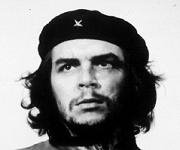
Che Guevara, is a romantic figure, whom I always saw as some kind of a guerilla fighter fighting imperialism. His description and short introduction in Encyclopaedia Britannica was all, that I knew of him, other than exquisite paintings/photos of him and quotes attributed to him.

How indeed was this guy transformed from a idealist youth in search of adventure and self-discovery to a communist who was responsible for the Cuban Revolution? A few answers were provided in the latest movie that I saw on DVD, "Motorcycle Diaries". A picturesque movie about two friends ('Che' and Alberto Gradando) on a motorcycle sojourn from Argentina to Venezuela, "Motor..." is a beautiful movie that provides glimpses of the early personality of Guevara. A honest person who is struck by sights of injustice, poverty, and disease, Guevara is a picture of idealist youth in this movie. His comical partner-in-tow Gradando however steals the movie as a happy-go-lucky adventurist in constant search for fun, but with an objective purpose about him.

I am now very much motivated to read more on Guevara and the Cuban Revolution. I even have a poster of Che saying "The basic clay our work is the youth, we place our hope in it and prepare it to take the banner from our hands" struck right on the wall next to my reading table now! If time and the situation permits, it wouldn't be too grand of me to say that I wish I could attempt a Guevara & Gradando in India on motorcycle next year, as soon as I finish my Masters. An one month trip would be worth trying!

Wednesday, October 05, 2005

Chappell vs Ganguly:

One issue that hogged the limelight throughout the Indian newspapers for a long time this past month was the Chappell-Ganguly imbroglio. Frankly speaking, I was too bored even to glance through this latest saga in the Indian cricket soap opera. For years, I have been pleading my case that Ganguly for all his so called aggression as a captain was a super-flawed cricketer who had increasingly become a bane to the Indian Test team rather than a boon. The Indian team under Ganguly has in the final analysis been just above-average and my thesis all along for this performance has been the introduction of young talent unencumbered by the weight of constant losing. Kaif, Yuvraj and Harbhajan were part of age group teams who were always winning competitions as youngsters and this eclectic mixture added tremendous value to the Indian team. Added to this, the metamorphosis of Dravid from a good to a great batsman was the reason for India's sporadic strong showing. All the credit that went to Ganguly for good performances, for me was rather out of place. To me, Ganguly was a supreme Machiavellian politician, using the rumblings in the Board and in the team to his benefit and performing when it least mattered (against teams of no intrinsic cricketing value), and maintaining his average in the early 40s by some means or the other.

Greg Chappell confirmed, what I had in mind all along, by calling a spade a spade. Unfortunately the muddle that the Indian media-the Board-the cricketing firmament is, Chappell's honesty and social constructivism has no role to play in a free-for-all realist power game that is Indian cricket. One needs to understand international politics to theorize Indian cricket, thats my honest opinion!

Thursday, August 11, 2005

Utsa Patnaik’s Article ( The Death Knell to the pro-reformer in me):

I had attended Prof Utsa Patnaik’s lecture on the agrarian sector’s travails during the times of economic reforms from the early 90s to the present, almost 4 months ago. She had then eloquently talked about how, poverty measures, based on per capita calorie intake of the populace, had shown that, owing to less purchasing power in the rural areas, there was a severe drop in calorie intake. This had resulted in a situation which entailed wide spread hunger and hence the entire episode of widespread farmer suicides in various rural areas in the country. At that time, I wasn’t good enough to understand the linkages between economic reforms, structural macroeconomic policies and spending in the social sector by government. Thankfully, some kind of sporadic but dedicated reading the past few months have educated me to a decent extent and to confirm my understanding, Prof Patnaik herself came up with a well written passionate essay, "Its time for Kumbakarna to wake up", elucidating the exact point mentioned above and exhorting the existing UPA dispensation to work toward ameliorating the fast deteriorating economic conditions of the rural poor.

Prof Zoya Hasan, who teaches Political Science and the erstwhile Chairperson of our department, was also cogent in her exposition of the repercussions of the economic reforms of 1991 in our country. While alluding to the fact that despite some economists saying that the economic reforms of 1991 were inevitable, there existed others who doubted whether we required such measures of opening up the floodgates of the erstwhile semi-closed economy; she also explained how concomitantly the economic reforms brought in dichotomous results: High Growth Rates ranging from 6 to 7% while at the same time exacerbating the disparities in our society.

She went on to quote the Prof Utsa Patnaik findings on the effects on the rural sector; asserted how economic problems faced by the rural poor were one particular reason apart from the Gujarat Riots for the fall of the NDA Government and also talked about in length about the political economy of the 1990s in India. Particular notice was mentioned on the astonishing finding that there was a stockpile of food grains in government godowns despite fall in food grain productivity (for the first time since 1962) during the NDA regime; yet millions of people were starving due to lack of purchasing power (because of the State’s withdrawal from managing the agrarian sector; this in turn being so due to the increased marketization of India’s economy).

She then hopped on to the current hot topic, National Rural Employee Guarantee Act, as to how this act is seen widely as a panacea to the problems of Rural India and how it could act as a much needed tonic to the unemployment problems of our country. Universal NREGA, as opposed to Targetted NREGA, with its side-by-side existence with the Right to Information Act and implementation by Panchayats constituted by the Panchayati Raj doctrine (Third Governance) was what was the need of the hour, several economists concurred, she said. She also mentioned about how certain newspapers took it their brief to scuttle this ambitious plan (the first of its kind in India to serve the interests of its own suffering citizens) by alluding that it was a fiscally imprudent exercise, despite assurance by several eminent economists about its overwhelming feasibility; its clone’s (in Maharashtra) successes, etc.